


 Updated
Contracts for Difference (CFDs) and Exchange-Traded Funds (ETFs) both provide access to a wide range of markets, but they work in very different ways. CFDs are leveraged derivative instruments that let traders speculate on price movements without owning the underlying asset. ETFs are exchange-traded funds that track an index, sector, or asset class and are bought and sold like shares.
Understanding how they differ in structure, cost, risk, and purpose can help you decide which one better fits your trading or investment approach.
Key Summary
- CFDs are leveraged derivatives that allow traders to take both long and short positions without owning the underlying asset, making them more suited to short-term, active trading strategies.
- ETFs are exchange-listed funds that track indices, sectors, or commodities, offering built-in diversification and a structure more aligned with longer-term investing.
- The main practical differences between CFDs and ETFs come down to ownership, leverage, costs, and risk profile. Each instrument suits a different type of market participant.
How CFDs and ETFs Actually Work
A CFD is a contract between a trader and a broker. You agree to exchange the difference in price of an asset from the point the contract opens to the point it closes. You never hold the underlying asset — whether that is a share, commodity, or index. Instead, your profit or loss reflects the price movement, multiplied by your position size.
ETFs work differently. When you buy an ETF, you are purchasing units in a fund that holds a basket of assets. A FTSE 100 ETF, for example, holds shares in all or most of the companies in that index. Your return reflects the performance of those underlying holdings, minus the fund’s management fee.
This structural difference shapes everything else — from how costs accumulate to how much risk you are exposed to at any given time.
Read here to find out more about how ETFs work.
Core Differences between CFD and ETFs
The table below summarises the core differences between CFDs and ETFs across key attributes.
| Attribute | CFD | ETF |
| Asset Ownership | No — you trade price movements | Yes — you hold units of the fund |
| Leverage | Available (amplifies gains and losses) | Generally not available |
| Primary Costs | Spread, overnight financing fees | Management fee (TER), brokerage commission |
| Risk Profile | Higher — losses can exceed deposit | Lower — limited to amount invested |
| Best For | Short-term speculation, hedging | Long-term investing, diversification |
| Regulation | Regulated broker product | Regulated fund product (e.g., UCITS) |
Leverage, Ownership, and Risk
Leverage is one of the most significant differences between CFDs and ETFs. CFDs are traded on margin, which means you only need to put down a fraction of the total trade value. This can increase potential returns, but it also increases potential losses. Depending on the broker and regulatory framework, losses may exceed your initial deposit.
Standard ETFs do not include built-in leverage. You invest the full amount, and your downside is generally limited to what you put in. Some leveraged ETFs do exist, but these are specialist products that behave differently from standard ETFs and carry additional risks.
Ownership is another key distinction. ETF investors hold units in a fund and therefore have exposure through an actual investment product. CFD traders hold a contractual position only. They do not own the underlying assets and do not receive shareholder rights such as voting rights. In some cases, CFD providers may apply dividend adjustments to relevant positions, but this is not the same as direct ownership.
Comparing Costs: Spreads, Fees, and Overnight Charges
The cost structure of CFDs and ETFs differs considerably, which affects how suitable each instrument may be for different time horizons.

CFD costs typically include:
- the spread, which is the difference between the buy and sell price
- overnight financing charges for positions held beyond the daily close
- possible commission on certain instruments, such as share CFDs
ETF costs typically include:
- the management fee, often shown as the Total Expense Ratio (TER)
- brokerage commissions when buying or selling on an exchange
- the bid-ask spread at the time of the transaction
For short-term trades held for hours or a few days, CFD costs may remain relatively manageable if overnight charges do not have much time to accumulate. For positions held over weeks or months, those financing costs can build up and erode returns. ETFs, by contrast, tend to have a lower and more predictable cost structure that suits longer holding periods.
Key Risks of Trading CFDs vs ETFs
Both instruments carry risk, but the nature and scale of that risk differ.
With CFDs, leverage means that adverse price movements can result in losses greater than the amount deposited. CFD traders may also face margin calls, which can force positions to close if the market moves sharply against them. Because CFDs are traded through a broker rather than bought on an exchange as fund units, counterparty risk is also a consideration.
ETFs have a different risk profile compared to CFDs, as they do not use leverage in their standard form and typically provide diversified exposure through a basket of assets. However, risk still depends on the underlying markets and the specific ETF structure. That said, ETFs that track highly volatile sectors or use leverage internally can still carry elevated risk.
Neither instrument is inherently safe. CFDs tend to suit traders who understand leverage and actively manage their exposure. ETFs tend to suit those seeking more measured, diversified market access.
CFD or ETF: Which Should You Choose?
There is no universal answer, but the right instrument largely depends on your approach to markets.
There is no universal answer, as the suitability of each instrument depends on your goals, time horizon, and risk tolerance.
CFDs may suit you if you:
- trade actively over short timeframes
- want to take both long and short positions
- are comfortable using leverage and managing margin
- want to hedge an existing portfolio against short-term downside
ETFs may suit you better if you:
- are investing over a longer time horizon
- prefer diversified exposure without managing individual positions
- want predictable, lower ongoing costs
- are less comfortable with leverage or overnight risk
It is also worth noting that CFDs and ETFs are not mutually exclusive. Some market participants use ETFs as a core holding and CFDs for shorter-term tactical positions or hedging.
CFD vs ETF: What About the S&P 500?
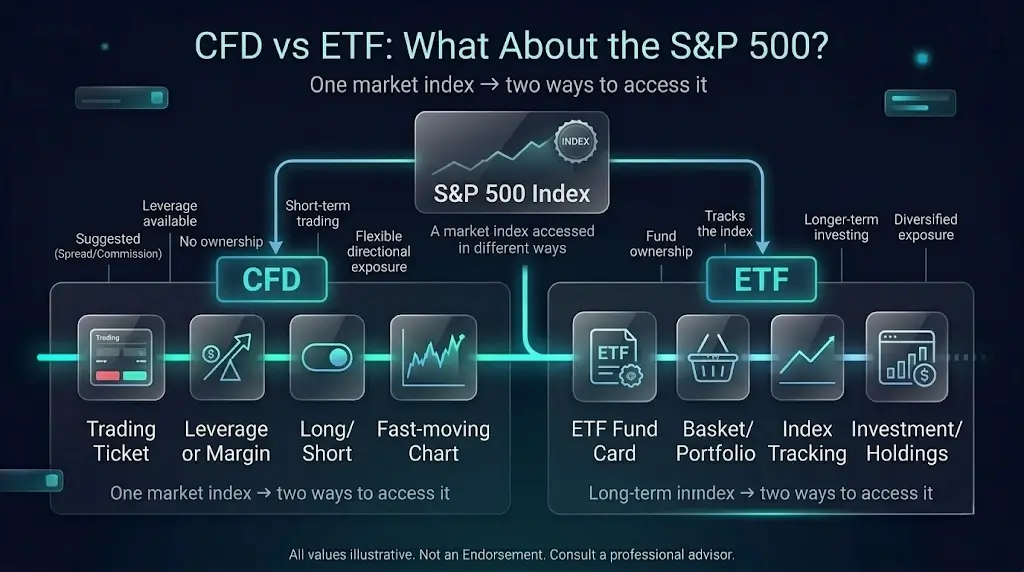
A common question is whether to access the S&P 500 through a CFD or an ETF. The S&P 500 is an index, not an instrument itself, so it can be accessed through both.
An S&P 500 CFD lets traders speculate on the index price in real time, often with leverage and without owning the underlying stocks. By contrast, an ETF holds the underlying shares and is designed to track the index’s performance, minus fees.
For a trader taking a short-term directional view on US equities, a CFD may offer more flexibility and lower upfront capital requirements. For an investor building long-term exposure to large-cap US stocks, an ETF is generally a more cost-efficient and straightforward structure.
CFD vs ETF: Which Is Right for You?
CFDs and ETFs serve different purposes. CFDs are built for active trading, offering leverage, flexibility, and the ability to trade rising or falling markets. ETFs, by contrast, are designed for investors seeking broad market exposure, lower long-term costs, and a more transparent structure.
Which one is right for you depends on your time horizon, risk appetite, and objectives. Both can provide access to similar markets, but they do so in very different ways.
If CFDs are more aligned with your approach, you may wish to explore how CFD trading platforms operate or consider using a demo account to familiarise yourself with trading mechanics before committing real funds.
Frequently Asked Questions (FAQs)
Should I Trade CFDs or Invest in ETFs?
This depends on what you are trying to achieve. CFDs are generally more appropriate for active, short-term trading strategies where leverage and flexibility are useful. ETFs are better suited to longer-term investors seeking diversified, lower-risk exposure. Many market participants use both, depending on their goals at any given time.
What Are the Main Risks of CFD Trading Compared to ETFs?
CFDs carry leverage risk, meaning losses can exceed your initial deposit. They also carry overnight financing costs and counterparty risk. ETFs carry standard market risk, but losses are limited to the amount invested, and the fund structure provides built-in diversification. ETFs tracking niche sectors or using internal leverage are an exception and carry higher risk profiles.
Can You Lose More Money Than You Invest With CFDs?
Yes. Because CFDs are leveraged products, a sharp move against your position can result in losses that exceed your initial deposit. Some regulated brokers may offer negative balance protection for retail clients, which is designed to prevent account balances from falling below zero. However, this does not remove the risk of losses, which can still be significant when trading CFDs.
Is the S&P 500 an ETF or a CFD?
Neither. The S&P 500 is a stock market index that tracks 500 large US-listed companies. It is not itself a tradeable instrument. You can gain exposure to the S&P 500 through an ETF (such as one tracking the index) or through a CFD that tracks the index price. Each approach has different cost structures, risk profiles, and ownership implications.
What Is ETF CFD Trading?
ETF CFD trading refers to trading a CFD whose underlying asset is an ETF rather than a stock, index, or commodity directly. This allows traders to take leveraged positions on ETF price movements without owning the ETF units. It combines the structural flexibility of CFDs with the diversified exposure an ETF typically provides.