


 Updated
The forex market is not well-suited for guesswork.
With over $9.6 trillion changing hands every day, forex is one of the most liquid markets in the world [1]. That scale brings opportunity, but it also brings noise — conflicting signals, sudden volatility, and the constant temptation to act on instinct.
A well-defined forex trading strategy cuts through that noise. It gives you a repeatable process to follow, which is what separates a trader who improves over time from one who simply reacts.
Key Points
- Forex trading strategies range from short-term setups like day trading to longer-term approaches such as swing, position, and carry trading — the right fit depends on your time, experience, and risk tolerance.
- Trend trading and swing trading are often seen as more accessible for beginners because they move at a slower pace and require less screen time.
- No strategy removes risk, so stop-loss placement and position sizing remain important across all approaches.
Forex Strategy Comparison at a Glance
Not sure where to start?
This table summarises the key differences between the 10 forex trading strategies covered in this guide, including a difficulty rating to help you find the most appropriate starting point or to consider whether active trading is appropriate for you at all.
| Strategy | Typical Holding Period | Time Commitment | Difficulty | Common Among |
| Day Trading | Minutes to hours | High | Intermediate–Advanced | Active traders with full session availability |
| Swing Trading | Days to weeks | Moderate | Beginner–Intermediate | Part-time traders and beginners |
| Trend Trading | Weeks to months | Low to moderate | Beginner | Patient traders following macro moves |
| Position Trading | Months to years | Low | Intermediate | Long-term traders with fundamentals knowledge |
| Carry Trade | Weeks to months | Low to moderate | Intermediate | Traders focused on interest rate differentials |
| Range Trading | Hours to days | Moderate | Beginner–Intermediate | Traders comfortable in sideways markets |
| Breakout Trading | Hours to days | Moderate | Intermediate | Traders who act quickly on momentum |
| News Trading | Minutes to hours | High during events | Advanced | Traders who follow the economic calendar closely |
| Grid Trading | Varies | Moderate to high | Intermediate–Advanced | Systematic traders in volatile conditions |
| Algorithmic Trading | Varies | Low once running | Advanced | Technically skilled traders comfortable with automation |
Short-Term Forex Trading Strategies
Short-term forex trading strategies mean fast decisions, tight margins, and a lot of screen time. They suit traders who are experienced, focused, and set up for rapid execution.
1. Day Trading
Day trading is a forex strategy where all positions are opened and closed within a single trading session. By closing trades before the day ends, traders avoid overnight exposure to price gaps and after-hours news.
Most day traders focus on one session — typically London or New York — where liquidity and volatility are highest. They usually look for intraday price moves shaped by technical patterns, session momentum, and scheduled economic releases.
This strategy suits traders who can commit several focused, uninterrupted hours to the market during their chosen session. Without that consistency, it becomes harder to follow setups and manage trades effectively.
Key features:
- All trades are closed before the session ends
- Relies primarily on technical analysis and intraday price patterns
- Economic data releases and news events can sharply affect intraday moves
- Common among traders with dedicated, distraction-free time during market hours
- Difficulty: Intermediate–Advanced
Medium-Term Forex Trading Strategies
Medium-term forex trading strategies do not require full-day attention. They suit traders who can set aside a few focused hours each week — without needing to watch every tick.
2. Trend Trading
Trend trading is a forex strategy that focuses on identifying a currency pair moving steadily in one direction and placing trades in line with that move until the trend begins to weaken or reverse.
Traders usually use moving averages, trend lines, and momentum indicators to confirm direction, then wait for a pullback or continuation setup before entering. It is generally used in markets showing sustained momentum, rather than ranging or choppy conditions.
Waiting for a clear trend, then waiting for a sensible entry within it, takes patience. Because the pace is slower and the direction is often easier to interpret than in short-term strategies, trend trading is often seen as more accessible for newer traders.
Key features:
- Holding periods range from weeks to months depending on trend strength
- Uses moving averages, trend lines, and momentum indicators to confirm direction
- Works better in sustained trending conditions than in sideways markets
- Common among traders who are comfortable waiting for clearer directional moves to develop
- Difficulty: Beginner

3. Swing Trading
Swing trading is a strategy that focuses on capturing directional price moves over several days to a few weeks. Traders often use support and resistance levels to plan entries, targets, and stop-loss points.
Traders look for clear turning points, then hold the position through the move rather than reacting to every short-term fluctuation. The daily or four-hour chart gives more time to assess the setup, manage risk, and plan the trade in advance.
Swing trading is often seen as more accessible for newer traders because it moves at a slower pace and does not usually require constant screen time. It may also appeal to traders who want a structured approach without making rapid decisions throughout the day.
Key features:
- Holding period of several days to a few weeks
- Uses support and resistance levels alongside indicators like RSI and MACD
- Does not require constant monitoring once a trade is placed
- Common among traders who prefer a slower pace and do not want to monitor charts constantly
- Difficulty: Beginner–Intermediate
4. Range Trading
Range trading is a forex strategy used in sideways markets, where traders buy near support and sell near resistance within a defined price range.
Not every market trends. Range trading focuses on periods of consolidation, when price moves between two levels without forming a sustained direction. Traders often use oscillators such as RSI and the stochastic oscillator to assess whether price is approaching overbought or oversold conditions within the range.
The main risk is a breakout. Once price moves beyond support or resistance with momentum, the range may no longer hold, and an open trade can turn quickly.
Key features:
- Relies on price staying within a consistent band
- Uses oscillators like RSI and the stochastic oscillator to identify overbought and oversold conditions
- Works best in low-volatility, consolidating market conditions
- Common among traders who are comfortable trading sideways markets and reacting quickly if a breakout occurs
- Difficulty: Beginner–Intermediate

Long-Term Forex Trading Strategies
Long-term forex trading strategies require less active management but demand a deeper understanding of macroeconomic factors. Central bank policy, interest rate differentials, inflation, and economic growth all play a role.
5. Position Trading
Position trading is a long-term forex strategy where traders hold positions for weeks, months, or longer, with decisions driven mainly by macroeconomic fundamentals rather than short-term chart patterns.
This approach focuses on the bigger picture, such as monetary policy cycles, economic divergence between countries, and longer-term shifts in trade flows. Short-term price swings matter less than whether the broader thesis remains intact.
Because trades are held over longer periods, positions can move against the trader before the wider view plays out. That makes patience, conviction, and tolerance for drawdown especially important.
Key features:
- Holding periods measured in weeks to years
- Fundamental analysis — GDP trends, monetary policy, trade balances — drives most decisions
- Requires a high tolerance for drawdown
- Common among traders who are comfortable holding positions through short-term price swings
- Difficulty: Intermediate
6. Carry Trade
The carry trade is a forex strategy where traders seek to benefit from the interest rate differential between two currencies by holding a position in a higher-yielding currency pair.
The mechanics are relatively simple. A trader holds a position in a currency with a higher interest rate while funding it with one that has a lower rate. How that differential is reflected in practice depends on the instrument and trading method used.
Carry trades tend to work better when interest rate gaps remain wide and market volatility stays relatively low. They can come under pressure during risk-off periods, when higher-yielding positions are unwound and funding currencies strengthen quickly.
Key considerations:
- Holding periods can range from days to months, depending on the macro backdrop
- Common carry pairs include AUD/JPY, NZD/JPY, and during periods of US rate dominance, USD/JPY
- Driven mainly by interest rate differentials and broader monetary policy trends
- Common among traders who follow macroeconomic trends and are comfortable with longer holding periods
- Difficulty: Intermediate
Volatility-Based Forex Trading Strategies
Not every trading opportunity comes from a trending or ranging market. Some of the sharpest moves in forex occur during moments of volatility — when price breaks free from consolidation or when a major economic release hits the market.
The two strategies in this section are built specifically for those moments.
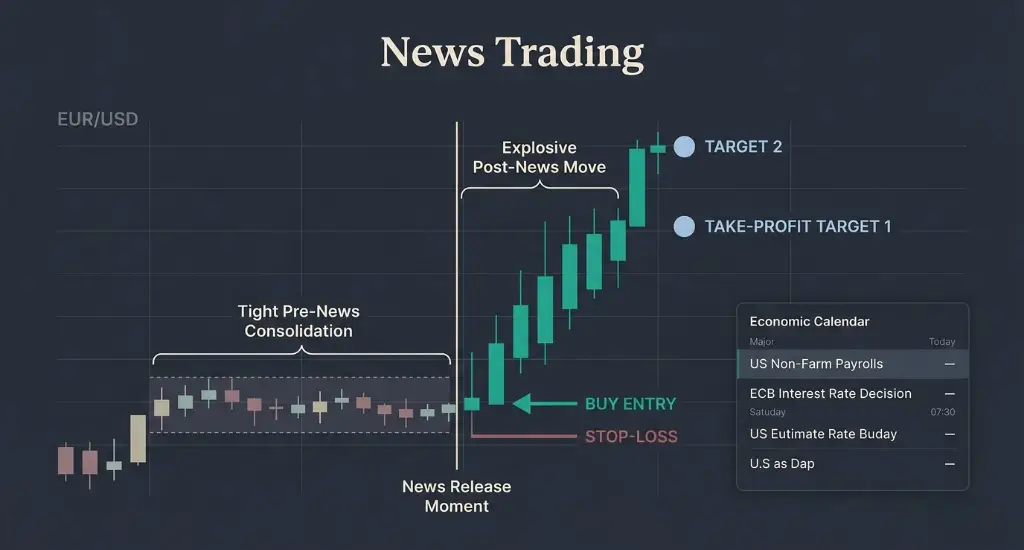
7. News Trading
News trading is a forex strategy built around major scheduled economic releases, such as interest rate decisions, non-farm payrolls, and GDP reports, which can trigger sharp moves in currency pairs.
The strategy focuses on trading around that volatility, either by entering before an event or reacting once the data is released. Around major announcements, spreads can widen, slippage can increase, and market reactions may not always follow the headline number in a straightforward way.
This is particularly relevant for CFD traders, where spreads and margin requirements can shift rapidly around major announcements. Because of that, news trading is generally seen as one of the more demanding strategies to execute consistently.
Key features:
- Driven by the economic calendar and defined event windows
- Spreads and slippage can increase around major announcements
- Market reactions can be rapid and sometimes counterintuitive
- Common among traders who closely follow macroeconomic releases and can respond quickly
- Difficulty: Advanced
8. Breakout Trading
Breakout trading is a forex strategy where traders enter when price moves decisively through a key support or resistance level, expecting momentum to continue in that direction.
The main challenge is false breakouts, where price briefly moves beyond a level before reversing. To reduce that risk, traders often look for confirmation such as stronger momentum, higher trading activity, or a full candle close beyond the level.
Breakout setups are commonly watched during consolidation periods or around major economic releases, when price is more likely to move out of a defined range.
Key features:
- Entry is triggered when price breaks out of a defined range or chart pattern
- Traders typically look for fast execution and consider stop-loss placement below the broken level
- Often used around consolidation periods or ahead of major economic releases
- Common among traders who are comfortable acting quickly when price confirms a move
- Difficulty: Intermediate
Systematic Forex Trading Strategies
Some forex trading strategies take discretion out of the equation entirely. Rather than reading the market in real time, systematic approaches follow a fixed set of rules — and execute trades based on predefined rules while still requiring ongoing human oversight.
Grid trading and algorithmic trading both fall into this category, though they differ significantly in complexity and the skills required to run them well.
9. Grid Trading
Grid trading is a systematic forex strategy that places buy and sell orders at set price intervals above and below the current market price, aiming to capture repeated price movement within a range rather than rely on a single directional view.
As price moves through the grid, orders are triggered automatically at predefined levels. The strategy is often used in markets that continue to fluctuate within a band, where price moves up and down without forming a strong sustained trend.
The main risk is a one-way move. If the market trends strongly without reversing, positions can build up on the wrong side of the move, significantly increasing margin exposure and potentially triggering a margin call or stop-out.
Key features:
- Uses a series of preset buy and sell orders at regular intervals
- Can be run manually or automated through a trading platform
- Risk increases sharply if the market trends strongly without reverting
- Common among traders who are comfortable with rule-based execution and close risk control
- Difficulty: Intermediate–Advanced

10. Algorithmic Trading
Algorithmic trading, also called automated or algo trading, is a forex strategy where computer programs execute trades based on predefined rules. It reduces manual decision-making during execution, but still requires human input in strategy design, testing, and oversight.
The rules can be simple or highly complex. “Buy when the 50-day moving average crosses above the 200-day” is a rule. More advanced systems may combine momentum signals, volatility filters, and time-based conditions across several currency pairs at once.
Its main strength is consistency. Its main limitation is that it can only respond to the conditions it was built to recognise, which is why monitoring and maintenance remain important.
Key features:
- Executes trades automatically based on coded rules
- Can monitor multiple pairs and timeframes simultaneously
- Requires technical skills to build, backtest, and maintain
- Common among traders who are comfortable using rule-based systems and ongoing oversight
- Difficulty: Advanced
Which Forex Trading Strategy Is Best for Beginners?
The honest answer is: it depends on you. But there are patterns worth noting.
Beginners generally do better with forex trading strategies that do not demand constant attention, produce clearer trading signals, and allow time to think before acting. Trend trading and swing trading fit that description. The charts are easier to read, the signals less ambiguous, and there is no pressure to react within seconds.
News trading and algorithmic trading sit at the other end of the spectrum. Speed, volatility, and very little margin for error — not the ideal combination for someone still learning the fundamentals.
A few things to consider before settling on a strategy:
- Time available: Day trading require hours of focused daily attention. Swing and trend trading need a few hours a week. Position trading needs only periodic check-ins. Be realistic — a strategy you cannot follow consistently will not work.
- Risk tolerance: Short-term strategies involve more frequent trades and smaller individual risks. Longer-term strategies may see you sitting through significant drawdowns before the position resolves. Know which you can handle before you start.
- Experience level: Algorithmic trading and news trading require background knowledge that takes time to build. For that reason, beginners often find it easier to start with a more straightforward strategy.
How to Build Your Own Forex Trading Strategy
Most traders begin by following an existing strategy rather than creating one from scratch, and that is a perfectly reasonable place to start.
Over time, understanding how a strategy is built makes it easier to adjust it, fix what is not working, and shape it into something that suits you better.
A functional forex trading strategy usually comes down to six core components:
- A defined market condition. Every strategy works better in some conditions than others. Define upfront which conditions activate your strategy — and which signal you to stay out entirely.
- Entry criteria. Specify exactly what has to happen before you enter a trade. “When RSI crosses above 30 on the daily chart after a confirmed swing low” is an entry criterion. “When the market looks like it might go up” is not. Vague criteria cannot be backtested.
- Exit criteria. Define your target and your stop-loss before you enter. Both should be based on price levels — support, resistance, measured moves — not arbitrary percentages. Know where you are going before you open the position.
- Position sizing rules. Decide in advance how much of your capital you risk per trade. As a general reference point, some traders use a figure between 1% and 2% of account equity, though the right amount varies by individual circumstances.
- A testing process. Backtesting on historical data reveals how the strategy has performed under past conditions. Forward testing on a demo account reveals how it performs in real time without risking capital. Neither is perfect, but both can help reveal whether a strategy is workable before real capital is involved. However, past performance revealed through backtesting is not indicative of future results.
- Risk management. A strategy also needs clear rules for managing risk on every trade. This often includes where the stop-loss goes, how much capital is risked, and whether the potential reward justifies the risk being taken. Without this, even a well-structured strategy can break down quickly.

Choosing the Right Forex Trading Strategy
No forex trading strategy works for everyone. The 10 strategies covered here span different timeframes, complexity levels, and trading styles, with each reflecting a different approach to the market.
The more useful question is not “which strategy is most profitable?” but “which strategy can I apply consistently, given my time, risk tolerance and experience level?” That question tends to lead to a more practical answer.
Frequently Asked Questions
Which Is the Best Strategy for Forex Trading?
There is no single best forex trading strategy — it depends on the trader. The right approach aligns with your available time, risk tolerance, experience, and objectives. Trend trading and swing trading are often highlighted as accessible starting points, but more experienced traders may find other approaches better suited to their style.
What Is the Most Successful Forex Strategy for Beginners?
Trend trading and swing trading are commonly cited as more accessible starting points for newer traders. Both use daily or four-hour charts, give traders time to plan entries without requiring instant reactions, and produce signals that are clear enough to evaluate and learn from.
News trading demand speed, tight spreads, and experience with volatility — conditions that make them poorly suited to traders still building foundational skills.
Can You Get Rich by Trading Forex?
Forex trading involves significant risk, and the majority of retail traders do not generate consistent profits over the long term. While the market offers genuine opportunities, consistent success requires knowledge, discipline, and sound risk management. Promises of guaranteed or rapid returns should be treated with a great deal of scepticism.
What Is the 5-3-1 Rule in Forex?
The 5-3-1 rule is a framework for keeping focus manageable: five currency pairs to follow, three strategies to practise, and one consistent time of day to trade. The goal is to avoid the very common mistake of spreading attention too thin before a solid foundation is in place.
RISK WARNING: CFDs are complex financial instruments and carry a high risk of losing money rapidly due to leverage. You should ensure you fully understand the risks involved and carefully consider whether you can afford to take the high risk of losing your money before trading.
Disclaimer: The information is provided for educational purposes only and doesn’t take into account your personal objectives, financial circumstances, or needs. It does not constitute investment advice. We encourage you to seek independent advice if necessary. The information has not been prepared in accordance with legal requirements designed to promote the independence of investment research. No representation or warranty is given as to the accuracy or completeness of any information contained within. This material may contain historical or past performance figures and should not be relied on. Furthermore estimates, forward-looking statements, and forecasts cannot be guaranteed. The information on this site and the products and services offered are not intended for distribution to any person in any country or jurisdiction where such distribution or use would be contrary to local law or regulation.
Reference
- “OTC foreign exchange turnover in April 2025 – BIS” https://www.bis.org/statistics/rpfx25_fx.htm Accessed 14 April 2026