


 Updated
Gold has rarely commanded as much attention as it does today.
After climbing more than 60% in 2025—its strongest year since 1979—and touching a record high above $5,500 an ounce in early 2026 before easing back towards $4,000 by mid-year, many people are asking whether gold is a good investment right now.1
The honest answer is that it depends on your goals, your time horizon, and the role gold plays alongside everything else you hold. A precious metal that pays no dividend income can still earn its place through portfolio diversification and as a store of value—but it can also sit flat for years. This guide seeks to weigh the case for and against gold so you can decide for yourself whether it suits your investing goals or not.
Key Points
- Gold is often regarded as a safe-haven asset and a store of value because it has historically tended to preserve purchasing power over long periods, although this is not guaranteed.
- Gold can act as a portfolio diversifier, as its price often moves independently of shares and bonds, which may cushion a portfolio during equity sell-offs.
- Gold pays no income, so its returns depend entirely on price movement, which means it can underperform dividend- or interest-paying assets over long stretches.
- Whether gold is a good investment right now depends heavily on your time horizon and entry point, as buying after a strong rally can raise the risk of a near-term pullback.
- Gold can be accessed in several ways—including physical bullion, gold ETFs, and gold CFDs—each carrying its own costs, risks, and level of oversight.
- Leveraged products such as gold CFDs can magnify both potential gains and potential losses, so they call for careful risk management rather than a buy-and-forget approach.
What Makes Gold a Good Investment In the Eyes of Some Investors?
Gold’s appeal rests on a handful of qualities that have held up across different market cycles. None of them guarantees a positive return, but together they explain why gold keeps its place in many portfolios.
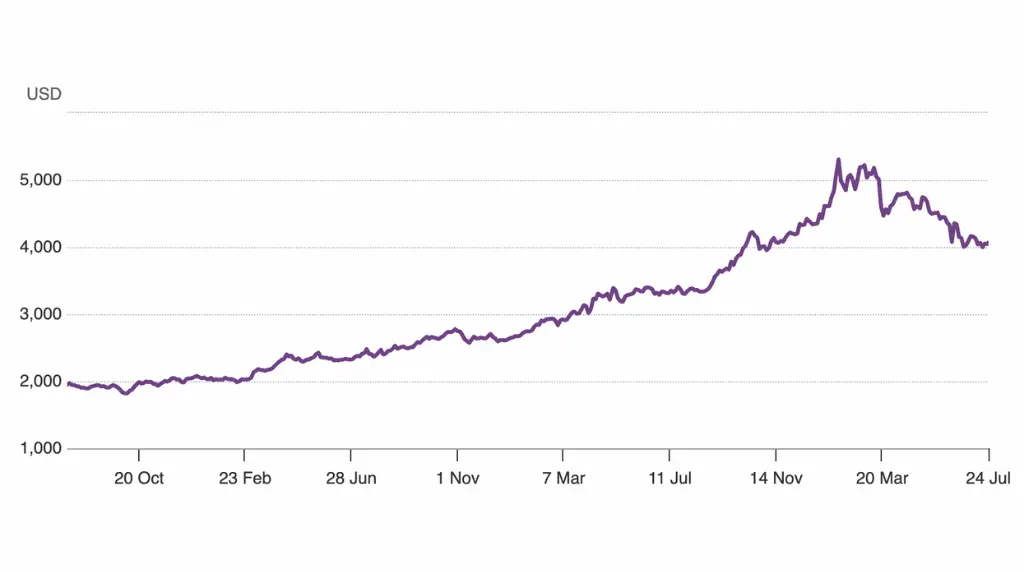
Image credit: World Gold Council
1. A Long-Standing Store of Value
Gold has been used as money for thousands of years, and it cannot be printed or diluted the way a currency can. That scarcity is part of why it’s often held as a store of value when confidence in paper money is tested. Demand from official institutions underlines this point: Central banks bought a substantial 863 tonnes of gold in 2025, well above the 2010–2021 annual average of 473 tonnes, as they continued to diversify their reserves.2
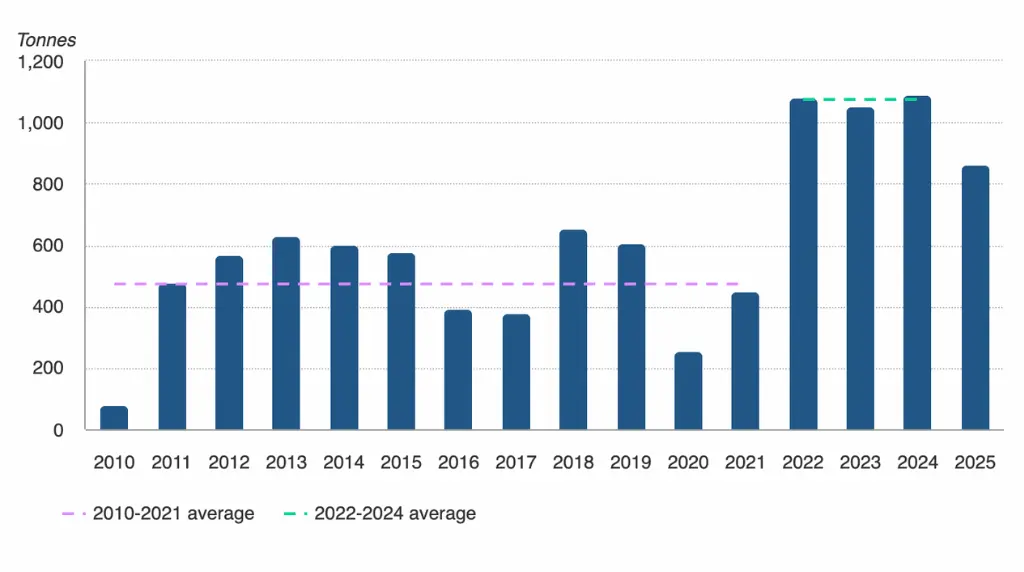
Image credit: World Gold Council
2. A Hedge Against Inflation and Currency Weakness
As gold is priced in US dollars (XAU/USD) and is nobody’s liability (theoretically speaking), it can hold value when inflation erodes cash or when a currency weakens. While this relationship is not perfect as gold can lag inflation over short windows, over longer periods, the precious metal has often helped preserve purchasing power.
For more details, read Vantage Markets’ guide on gold as a hedge against inflation.
3. A Portfolio Diversifier
Gold’s price often moves independently of shares and bonds, and it has sometimes risen when equities fall. Adding an asset that behaves differently can potentially help to reduce how much a portfolio swings overall.
That said, gold investors should note that diversification does not guarantee returns or remove the risk of loss entirely.
4. High Liquidity
Gold is one of the most traded assets in the world, underpinned by benchmarks such as the LBMA Gold Price. Deep liquidity often means that positions can usually be entered and exited without moving the market, which matters when conditions turn volatile.
Image credit: LBMA (London Bullion Market Association)
| Vantage Pro Tip: Treat gold as one component of a wider plan rather than a single bet. Deciding in advance what share of a portfolio you are comfortable holding in gold makes it easier to stay disciplined when prices move sharply in either direction. |
What Are the Risks of Investing in Gold?
Gold’s strengths come with real trade-offs. Weighing these against the potential advantages is essential because the same features that make gold attractive in one environment can work against you in another.
1. No Income or Yield
Gold pays no dividend or interest. Its entire return depends on the price rising, which means it can lag income-paying assets such as shares or bonds for long periods, particularly when interest rates are high.
2. Price Volatility
Gold can move sharply. Its volatility can deliver strong gains, as in 2025, but it can also produce steep and lasting drawdowns. In fact, gold fell for several years after its 2011 peak before recovering. Investors should always bear in mind that past performance is not a reliable indicator of future results.
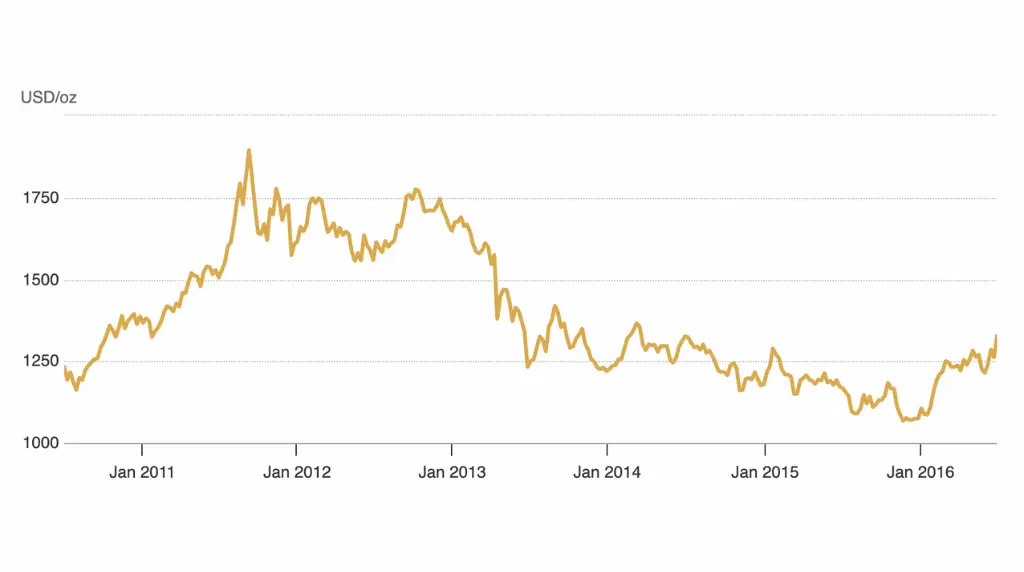
Image credit: World Gold Council
3. Opportunity Cost
Money held in gold is money not invested elsewhere. During long equity bull markets, a portfolio tilted towards gold can underperform one weighted towards productive, income-generating assets like stocks and ETFs (exchange-traded funds).
4. Costs of Ownership
What some investors forget to take note of is that owning gold is rarely free.
Physical bars and coins carry storage, insurance, and dealer spreads, while funds and leveraged products carry their own fees and financing costs. These expenses can affect your account balance and should be taken into account before you decide to invest in gold.
How Has Gold Performed Over Time?
Over the long run, gold has broadly held its value and, at times, delivered strong returns—but rarely in a straight line. The 2025 rally was exceptional, and buying after such a move carries different risks from buying during a quiet period. The illustration below shows how a hypothetical holding might have changed over a decade.
Case in point (hypothetical): Imagine investing $1,000 in gold roughly ten years ago and holding it.
| Assumption | Figure |
|---|---|
| Gold price, mid-2016 (approx.) | $1,340 / oz |
| Gold price, mid-2026 (approx.) | $4,000 / oz |
| Gold bought with $1,000 | ~0.75 oz |
| Hypothetical value after ~10 years | ~$2,985 |
| Hypothetical change | ~+199% |
This example is hypothetical and for illustration only. It excludes storage, spreads, fees and financing, uses rounded prices, and does not represent any real client outcome. Past performance is not a reliable indicator of future results, and gold can fall as well as rise.
The takeaway is not that gold always doubles in value (it does not), but that long-term investment can reward patience while testing it along the way. Returns would depend entirely on your entry and exit points.
Is Gold a Good Investment Right Now?
After a record-breaking run in early 2026, the case for gold today is more finely balanced than it was a year ago. Several advocates remain in place: Central banks are still accumulating reserves, and the World Gold Council’s 2025 survey found a record share of central banks planning to add gold, with none expecting to reduce holdings.2 A softer interest-rate environment can also help, as gold competes with yield-bearing assets.
Against that backdrop, prices sit far above their long-run average, and buying after a sharp rally can increase the risk of a near-term pullback. Analyst projections for the years ahead vary widely. J.P. Morgan has published its own outlook for gold prices, while some other analysts have presented more bullish scenarios. Investors should note that forecasts are not guarantees.3
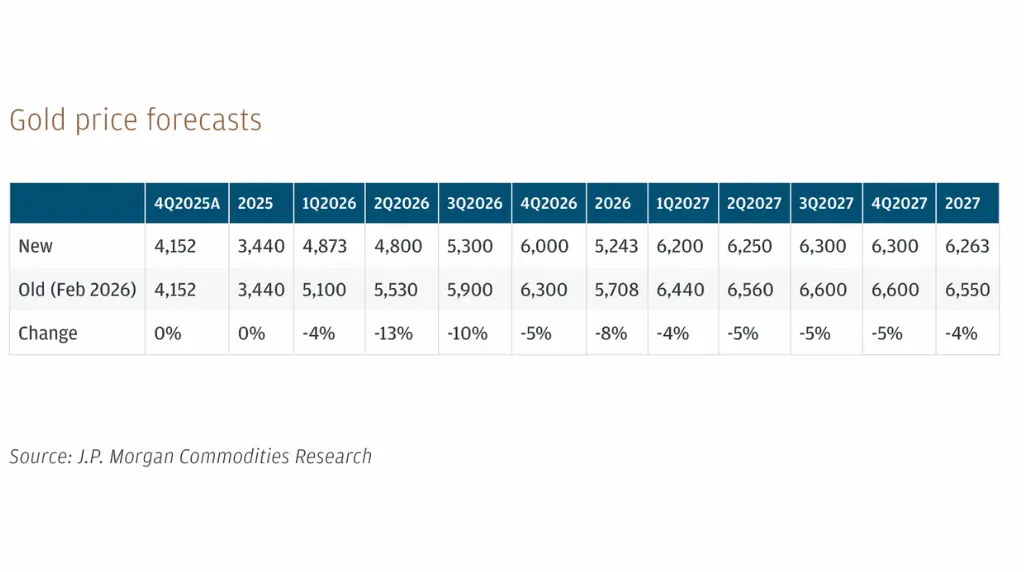
Image credit: J. P. Morgan
| Vantage Pro Tip: Rather than trying to time a single entry, some gold traders and investors build exposure gradually and size positions so that a sharp move against them would not be damaging. You can practise this approach in a demo environment using virtual funds with a Vantage Demo Account. |
How Does Gold Compare to Other Assets?
Gold looks different depending on what you compare it with. The table below sketches how it stacks up against a few common asset types on the characteristics that matter most to investors.
| Asset | Income | Typical volatility | Main role |
|---|---|---|---|
| Gold | None | Moderate to high | Diversifier, store of value |
| Shares | Dividends (variable) | High | Long-term growth |
| Bonds | Interest (fixed) | Low to moderate | Income, stability |
| Cash | Interest (variable) | Very low | Liquidity, safety |
Gold and shares are often weighed against each other in particular. For a deeper breakdown, see Vantage Markets’ comparison guide on gold vs. stocks.
What Are the 4 Main Ways to Get Gold Exposure?
There is no single way to invest in gold, and the right route depends on how much control, cost, and oversight you want. Here are four common ways to add gold to your portfolio:
1. Physical Gold
- Gold bars and coins provide direct ownership, but typically come with dealer premiums or spreads, secure storage, insurance and, in some cases, authentication or resale costs.
- Best suited for gold investors who want to hold the underlying metal over the long term and are comfortable managing these additional costs and practical considerations.
2. Gold ETFs
- Gold ETFs provide exchange-traded exposure to gold without requiring investors to store the metal themselves.
- Depending on the fund, it may hold physical bullion, use derivatives, or follow another gold-related strategy, so investors should review its structure and investment objective before investing.
- ETF shares trade on an exchange at market prices, which may differ slightly from the value of the fund’s underlying assets.
- Management fees, trading costs and tracking differences can also affect returns.
Vantage Markets’ listicle of the best gold ETFs compares several options by cost and features.
3. Gold Mining Shares
- Gold mining shares provide ownership in companies involved in gold exploration or production rather than direct exposure to the metal itself.
- Prices may rise more sharply than gold during favourable conditions because higher gold prices can increase miners’ profit margins.
- However, mining shares remain exposed to company-specific and broader equity-market risks, including production costs, management decisions, political developments, and operational disruptions.
- Some gold mining companies pay dividends, although these payments are not guaranteed and may be reduced or suspended at any time.
4. Gold CFDs
- A gold contract for difference (CFD) allows traders to speculate on whether the price of gold will rise or fall by taking a long or short position without owning the underlying metal.
- CFDs are commonly traded on margin and use leverage, meaning traders can control a larger position with a comparatively smaller initial deposit. However, leverage magnifies both gains and losses.
- If losses reduce the account’s margin level below the broker’s required threshold, positions may be closed automatically under the applicable margin-close-out or stop-out rules. The precise thresholds and protections depend on the broker, account type, entity and jurisdiction.
As leverage is central to CFD trading, traders should understand margin requirements, position sizing, financing charges, and liquidation risk before opening a position.
Leverage is central to how CFDs work, so it is worth understanding leverage before trading. Eligible clients may explore gold CFD trading on the Vantage Markets platform with a Vantage Live Account, subject to product availability in their jurisdiction. Meanwhile, if you’d like to dive deeper into the subject, check out Vantage Markets’ guide on how to invest in gold.
Who Might Gold Suit?
Whether gold is suitable depends on the investor’s objectives, time horizon, financial circumstances, and risk tolerance.
Note: The following is a general guide rather than personal investment advice.
Gold may be more suitable for investors who:
- Want to diversify a portfolio beyond shares and bonds;
- Have a medium- to long-term investment horizon;
- Are seeking partial protection against inflation, currency weakness, or periods of market stress; and
- Can tolerate price volatility and the absence of regular income
Gold may be less suitable for investors who:
- Rely on their investments to generate dividends or interest;
- May need to access their capital in the near term;
- Have a low tolerance for price fluctuations; or
- Would be uncomfortable holding an asset that could underperform for an extended period
Gold should generally be considered in the context of the wider portfolio rather than as a standalone decision. Where appropriate, investors are recommended to seek independent financial advice from a professional before committing capital.
Weighing Up Gold in Your Portfolio
So, is gold a good investment? It can serve as a portfolio diversifier and may help preserve value during certain periods of inflation, currency weakness, or market stress. However, gold does not generate income, its price can be volatile, and there’s no guarantee it will retain or increase its value.
Instead, the more useful question is whether gold complements your objectives, time horizon, risk tolerance, and existing portfolio exposure. Position size, holding method, and costs can also materially affect the outcome.
Before committing capital, compare the different ways to gain gold exposure and consider how each fits your broader investment plan. Investors seeking ownership or longer-term exposure may consider physical gold, gold ETFs, or mining shares. Meanwhile, traders who want to speculate on shorter-term price movements may explore gold CFDs with Vantage Markets, subject to the risks of leverage.
FAQs
Is gold a good investment for the long term?
Gold has broadly held its value over long periods and can help diversify a portfolio, which is why many investors hold it for the long term. However, the precious metal doesn’t generate dividends or interest, and it can experience prolonged periods of weak or negative returns. Whether gold is suitable for a long-term portfolio depends on factors such as your objectives, time horizon, existing investments, and tolerance for price volatility.
Will gold be worth more in 10 years?
No one can predict gold’s price 10 years from now with certainty. Although gold delivered strong returns over the decade to the end of 2024 and continued reaching record highs in 2025, past gains do not guarantee that prices will continue rising at the same rate.
Gold’s future performance is likely to depend on factors including inflation, real interest rates, central-bank demand, investor sentiment, geopolitical risk, and movements in the US dollar. A longer holding period may give investors more time to absorb short-term volatility, but it does not eliminate the possibility of loss.
How high can gold go by 2030?
Forecasts vary widely and none can be guaranteed. Published analyst projections differ depending on the assumptions used and forecasts are not guarantees.3 These estimates depend on assumptions about interest rates, central bank buying, and the US dollar, all of which can change. Treat them as scenarios rather than targets.
Will gold reach $10,000?
Some analysts have modelled scenarios in which gold reaches $10,000 an ounce or more, but these sit at the bullish end of a wide range of published forecasts and are far from certain.3 Reaching such a level would likely require sustained central bank demand, rising government debt, and continued currency debasement.
However, $10,000 sits at the upper end of published forecasts and would require a substantial rise from current levels. Gold could instead trade below that figure or decline if factors such as real interest rates, the US dollar, or investor demand move against it.
Is gold a good investment for beginners?
Gold may provide beginners with a way to diversify beyond conventional shares and bonds, but it should not be viewed as automatically safe or profitable. Its price can fluctuate significantly, and physical bullion does not generate dividends or interest.
Exchange-traded products backed by physical gold can offer a more accessible way to obtain gold exposure without arranging personal storage, although management fees, brokerage costs, tracking differences, and fund structure should still be considered.
Gold CFDs serve a different purpose. They are leveraged derivatives used to speculate on price movements rather than to own gold as a long-term investment. Beginners considering CFDs should first understand leverage, margin requirements, financing costs, and the risk of rapid losses. A demo account can help users practise the platform mechanics with virtual funds, although simulated trading may not fully reproduce live-market execution or the emotional effects of risking real money.
Is gold better than shares?
Neither gold nor shares are universally better because they perform different roles.
Shares represent ownership in companies and may provide capital growth and dividend income. Gold does not generate income, but it may offer diversification and can perform differently during certain periods of inflation, currency weakness, or market stress.
Some investors therefore hold both rather than relying entirely on one asset class. The appropriate balance depends on the investor’s objectives, time horizon, and tolerance for risk. Vantage Markets’ guide to gold versus stocks compares their characteristics, potential uses, and key risks in more detail.
RISK WARNING: CFDs are complex financial instruments and carry a high risk of losing money rapidly due to leverage. You should ensure you fully understand the risks involved and carefully consider whether you can afford to take the high risk of losing your money before trading.
Disclaimer: The information is provided for educational purposes only and doesn’t take into account your personal objectives, financial circumstances, or needs. It does not constitute investment advice. We encourage you to seek independent advice if necessary. The information has not been prepared in accordance with legal requirements designed to promote the independence of investment research. No representation or warranty is given as to the accuracy or completeness of any information contained within. This material may contain historical or past performance figures and should not be relied on. Furthermore estimates, forward-looking statements, and forecasts cannot be guaranteed. The information on this site and the products and services offered are not intended for distribution to any person in any country or jurisdiction where such distribution or use would be contrary to local law or regulation.
References
1. Gold Prices and Market Data – World Gold Council. https://www.gold.org/goldhub/data/gold-prices. Accessed on 19 July 2026.
2. Gold Demand Trends: Q4 and Full Year 2025, Central Banks – World Gold Council. https://www.gold.org/goldhub/research/gold-demand-trends/gold-demand-trends-full-year-2025/central-banks. Accessed on 19 July 2026.
3. Gold Price Predictions for 2026 and 2027 – J.P. Morgan Global Research. https://www.jpmorgan.com/insights/global-research/commodities/gold-prices. Accessed on 19 July 2026.