


 Updated
Markets have been showing cracks lately, and nowhere is that more evident than in tech stocks tied to the AI bubble narrative. The Nasdaq Composite briefly slid nearly 2% last week, with the sharpest losses concentrated in Artificial Intelligence (AI) names — a sign that AI valuations may be entering a bubble phase.
These are the very companies that had led the charge higher earlier this year. Think Nvidia Corporation (NASDAQ: NVDA), Palantir Technologies (NASDAQ: PLTR), and Arm Holdings (NASDAQ: ARM)—three of the most recognisable chip players driving the AI investing boom and fuelling talk of a possible AI stock bubble.
All three suffered steep declines, which naturally reignited the debate dominating the sector right now: is the AI bubble starting to burst, or is this a healthy correction in tech stocks?
Key Points
- AI stocks such as Nvidia, Palantir, and Arm have faced sharp pullbacks as stretched valuations, hype-driven demand, and fragile sentiment weigh on investor confidence.
- Analysts warn of bubble-like conditions, with optimism and valuations running ahead of fundamentals, drawing frequent comparisons to the dot-com boom.
- Despite short-term volatility, AI continues to transform industries, with long-term adoption expected to outlast current market corrections.
What Is the AI Bubble and Why It Matters?
The term AI bubble refers to the idea that current enthusiasm and investment in artificial intelligence may be outpacing its real-world commercial returns. In other words, market valuations are rising faster than proven profitability — a pattern seen before in past financial bubbles.
History offers many lessons. The most-cited example is the Tulip Mania of the 1600s [1]. Others include the South Sea Bubble of the 1700s, the dot-com boom and crash of the late 1990s, and the US housing bubble that led to the Global Financial Crisis (GFC) of 2007–2009.
The common thread across these periods is simple: investors pour money into the next big idea, valuations become detached from underlying fundamentals, and prices eventually correct when expectations meet reality.
The AI investing bubble, if it exists, would follow the same pattern — fuelled by optimism, easy capital, and transformative promises that take longer to materialise than markets expect.
Why Many Analysts Call It an AI Bubble
Analysts and market commentators often cite three core reasons behind the AI bubble narrative: stretched valuations, hype-driven demand, and investor optimism that outpaces real business fundamentals.
1. Valuation Stretch
In the eyes of many professional investors, AI leaders are priced for perfection. Nvidia trades at a trailing P/E ratio of roughly 58 (as of 22 August 2025), while Arm Holdings trades at close to 143 (as of 22 August 2025), compared to the semiconductor industry’s long-term average of about 20 [2,3].
Even the Nasdaq-100 itself looks pricey, trading at 35 times its trailing earnings versus a 10-year average of 25 times. High valuations can be justified in periods of rapid growth, but they leave very little margin for error.
2. Hype-Driven Demand
Generative AI breakthroughs have fueled a surge in AI hype. Investors aren’t just chasing the big names; they’re bidding up anything with an AI angle.
The Aventis AI Valuations Index is up 166% in less than three years, outpacing the S&P 500 Index by a wide margin [4]. Even “picks and shovels” suppliers, from data centre contractors to HVAC makers, have seen shares jump 800% to 1,200%, based purely on the perception that they’re tied to the AI boom.
The “DeepSeek scare” earlier this year, when a cheaper Chinese rival model temporarily sent AI stocks in the US tumbling before they quickly rebounded, shows just how fragile sentiment can be.
3. Investor Optimism Outpacing Fundamentals
Here’s the disconnect: while valuations scream sky-high growth, the reality is murkier. A widely-publicised report from the Massachusetts Institute of Technology (MIT) recently found that 95% of corporate AI projects aren’t generating meaningful returns yet [5].
Only a handful are moving the revenue needle, but markets are pricing AI stocks as if adoption is already widespread and profitable. It’s the same playbook we saw in the dot-com era: a few success stories driving sky-high optimism, while most pilots remain unproven in terms of generating new streams of revenue or cost synergies.
The Transformative Reality of AI vs. Market Expectations
It’s worth noting that calling AI a “bubble” does not mean dismissing the technology itself. AI is already transforming sectors such as healthcare, finance, and productivity.
The real risk is that markets may have priced in decades of growth overnight, leaving valuations vulnerable if adoption proves slower than expected. Put simply: AI may well change the world but stock prices don’t always move in a straight line.
Why Have AI Stocks Been Falling?
The week ending 22 August highlighted how quickly market sentiment can shift. The Nasdaq slipped 1.5%, weighed down by technology shares, even as the Dow Jones Industrial Average reached a new record high and the S&P 500 posted a modest 0.3% gain [6].
Midweek, the Philadelphia Semiconductor Index tumbled before rebounding 2.7% on Friday [7]. The sharpest declines were concentrated in AI bellwethers like Nvidia, Palantir, and Arm, highlighting just how much AI hype is dictating broader tech stock performance.
Several triggers converged to spark the selloff:
- Concerns over earnings momentum: Investors grew cautious ahead of Nvidia’s upcoming earnings report (27 August after the close), which has effectively become a referendum on the entire AI trade. With valuations already stretched, even small disappointments could trigger outsized reactions. Meanwhile, companies like Palantir faced profit-taking after a parabolic run, exposing weakness once sentiment turned.
- Slower-than-expected adoption headlines: An MIT study highlighted that around 95% of enterprise AI pilots are failing to deliver meaningful returns, feeding scepticism that corporate adoption is lagging the hype. This raised doubts about how soon companies can translate AI excitement into revenue, reinforcing fears that current valuations are running ahead of fundamentals.
- Geopolitical and supply-chain risks: Reports that Nvidia asked Foxconn to suspend work on its China-focused H20 chip injected fresh uncertainty into a critical market. Investors interpreted this as another reminder that export restrictions and geopolitical tensions could constrain AI hardware sales, especially in China, which is one of the largest end-markets. Want to learn more about how trade tensions are reshaping the AI hardware race? Read our related article, “Nvidia in the Crossfire: When Trade Wars Target AI Chips.”
- Broader market sentiment and positioning: Ahead of Jerome Powell’s Jackson Hole speech, markets saw heavy de-risking, with investors rotating into defensives and bonds. Given how crowded AI stocks have become, they were the first to be sold as traders locked in profits and reduced exposure to rate-sensitive growth names.
While Powell’s dovish tone on Friday helped ignite a relief rally, particularly in semiconductors and small caps, the week’s volatility underscored a key takeaway: sentiment around AI remains fragile.
Investors are still bullish on the long-term potential of the technology, but the trade is highly sensitive to earnings visibility, adoption headlines, and policy risks.
AI Bubble vs Dot-Com Bubble: Similarities and Differences
The current AI boom invites frequent comparisons with the dot-com bubble of 1999 to 2000 and they do indeed have many similarities but, crucially, also key differences.
Similarities
- Speculative Enthusiasm: Investors are piling into AI stocks based on future potential, much as they did with internet startups two decades ago.
- Valuation Excess: In 2000, the S&P Tech sector traded at around 48 times its forward earnings [8]. Today, Nvidia trades at around 70 times its trailing earnings, while Arm pushes toward 90 times. These are levels that evoke Cisco Systems at the peak of the dot-com mania.
- Overinvestment: The dot-com bubble saw billions invested in websites and telecom infrastructure. Today, the race to build AI data centres and buy chips risks oversupply if adoption slows.
Differences
- Tangible Use Cases: Unlike many dot-com firms, AI already powers search engines, digital advertising, drug discovery, and coding assistants. In other words, they have real-life and use-case benefits right now – unlike the Internet’s impact on companies in the dot-com era.
- Profitable Leaders: Today’s giants, such as Microsoft Corporation (NASDAQ: MSFT), Alphabet Inc (NASDAQ: GOOGL), and Nvidia, are highly profitable, cash-rich, and systemically important. They differ from the mostly pre-revenue dot-com companies of the late 1990s.
- Capital Intensity: AI requires enormous capital investment in chips and cloud infrastructure, making it harder for smaller players to compete when compared to the dot-com era.
Lessons from History
- The Nasdaq lost around 77% of its value between 2000 and 2002 [9].
- Yet the internet ultimately reshaped the global economy, giving rise to Amazon, Google, and the modern digital ecosystem.
- The takeaway: Short-term bubbles don’t invalidate long-term technological revolutions.
Warning Signs the AI Bubble Could Burst
Looking back at history such as the dot-com boom of the late 1990s, markets often show early signs when enthusiasm runs ahead of reality.
In today’s AI trade, some of these potential bubble markers are worth keeping an eye on:
- Elevated valuations: AI leaders like Nvidia and Arm are trading at multiples well above sector averages and their own history. While this reflects strong demand, it also means much of the future growth story is already priced in.
- Speculative flows: AI-focused ETFs have seen record inflows in 2024–25, echoing the kind of concentrated enthusiasm seen in past episodes like meme stocks. Such crowding can magnify both gains and pullbacks.
- Adoption gap: That MIT study about the adoption gap of AI is a timely reminder for investors that the commercial impact may lag the hype cycle.
- Volatility in indices: The Nasdaq’s sharp swings this week, led by moves in Nvidia, Palantir, and Arm, highlight how AI sentiment is increasingly dictating tech market direction. This creates both risk and opportunity.
AI Leaders Under Pressure
The recent pullback has been most visible in the market’s AI leaders. Below are three notable examples that illustrate how sentiment has shifted.
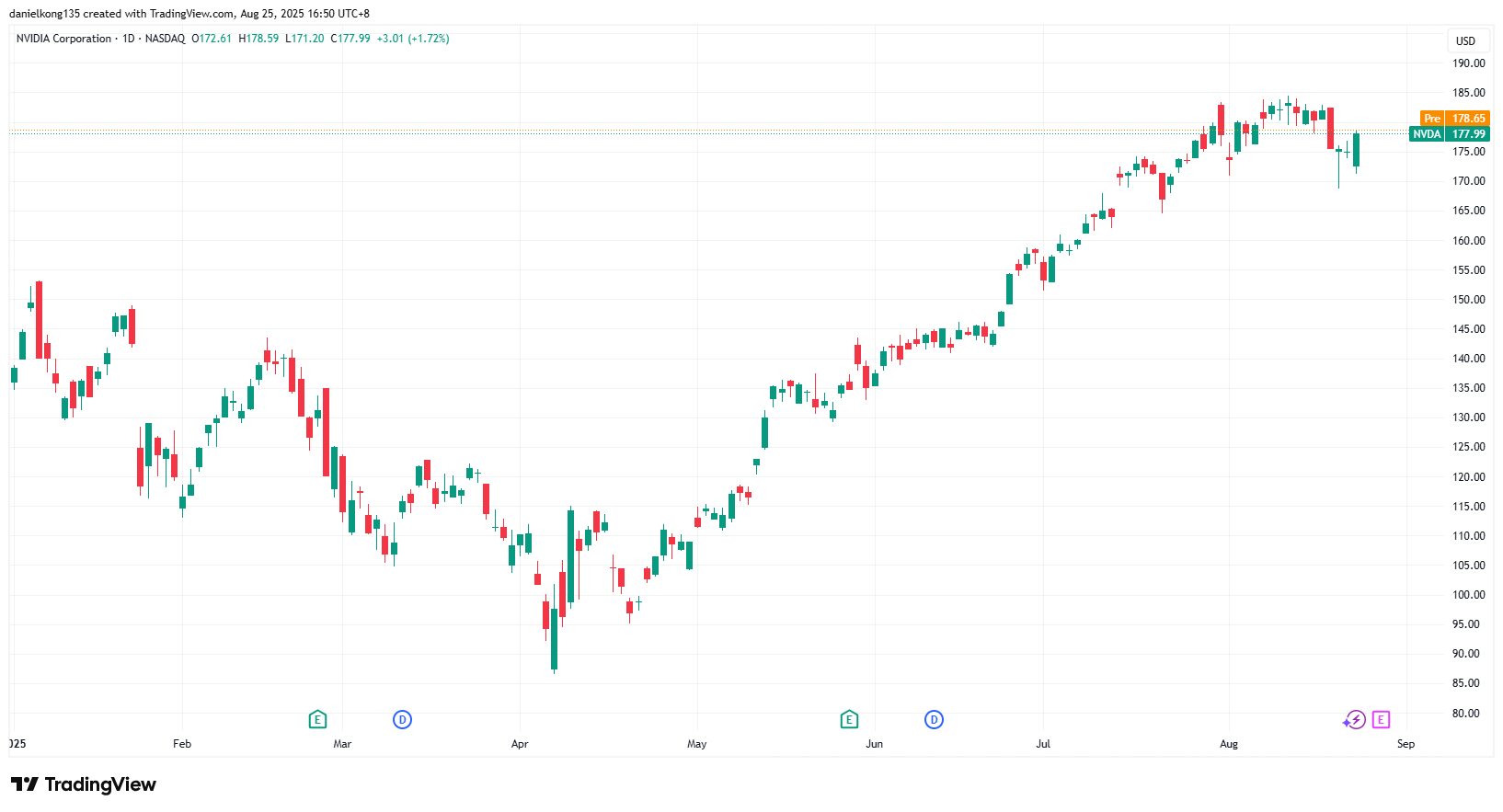
Nvidia (NVDA)
Nvidia remains a standout in the AI rally, with its stock climbing steadily through mid-2025. Recent fluctuations highlight investor caution, but the broader trend has so far been upward, though subject to volatility as markets weigh whether earnings growth can sustain this momentum.
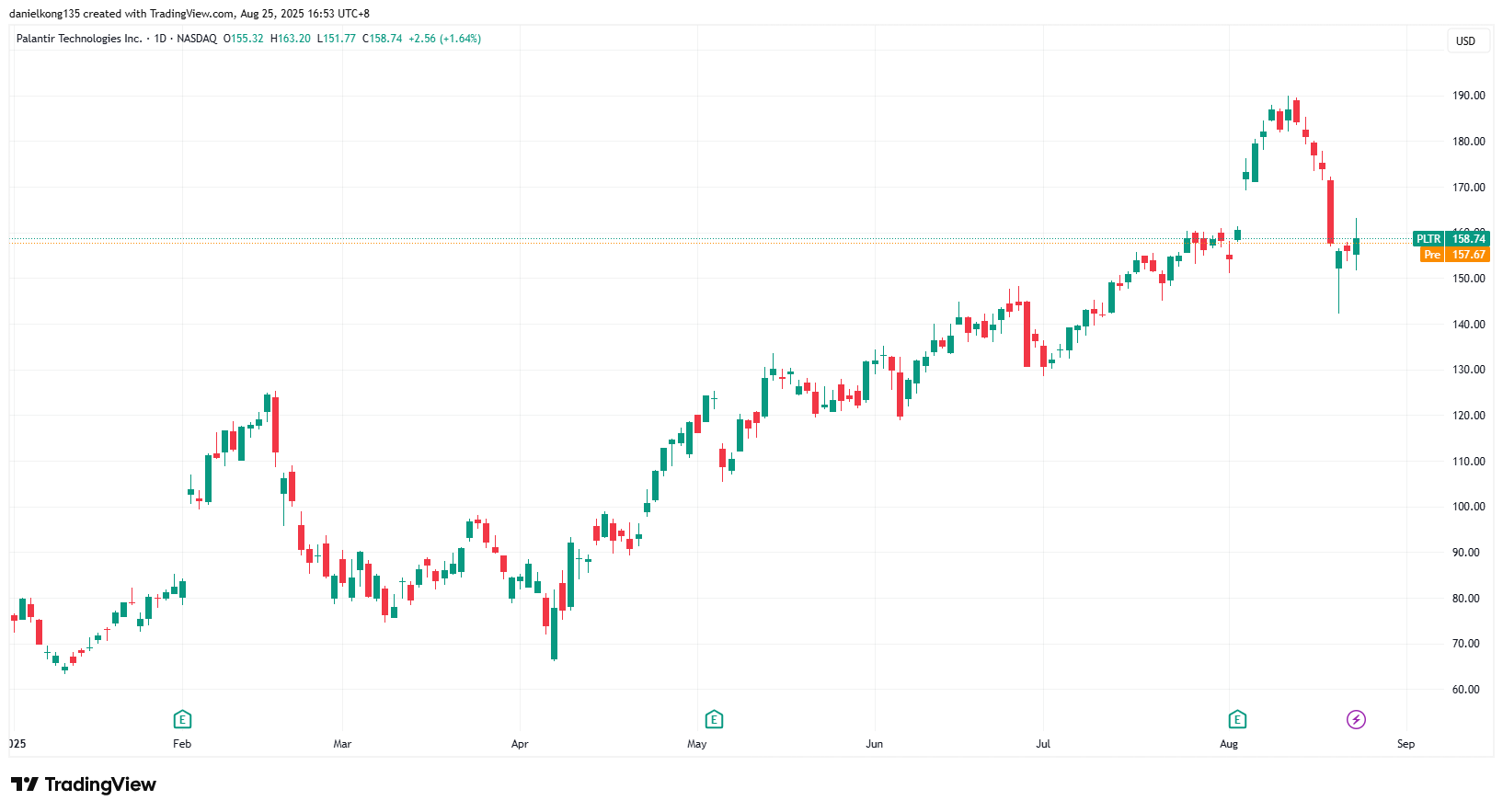
Palantir (PLTR)
Palantir surged through mid-2025 on AI enthusiasm and a strong earnings report, but the sharp pullback in August highlights how quickly sentiment can reverse when lofty growth expectations face scrutiny.
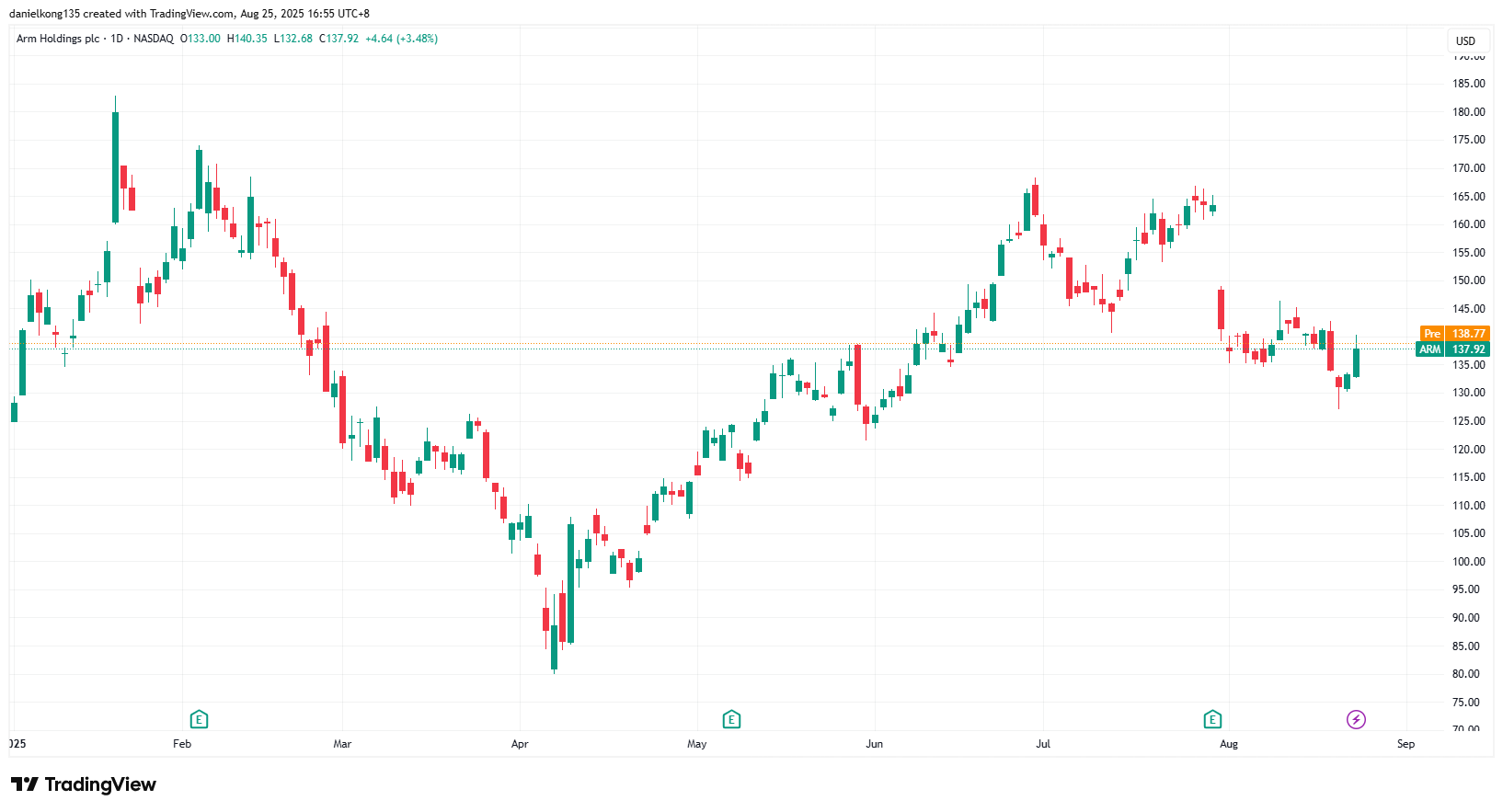
Arm Holdings (ARM)
Arm’s pullback from its July highs reflects the broader pressure on semiconductor stocks, especially those with premium valuations that leave little room for earnings disappointments.
For some investors, the worry is that valuations have stretched too far, too fast – in the process inflating shares prices more via excitement than by earnings power (i.e. actual fundamentals).
So let’s break down what an AI bubble means, why valuations are under scrutiny, how today’s market compares with the dot-com bubble, and what lessons investors might take from history.
What Could This Mean for the Wider Market?
AI stocks now make up such a large slice of the Nasdaq Index and S&P 500 Index that when they sneeze, the whole market catches a cold. Last week’s drop in Nvidia, Palantir, and Arm was a good reminder of just how much a handful of names can sway the indices.
When these leaders wobble, tech drags, and broader sentiment often follows. That kind of volatility doesn’t just move charts, it can spook investors into shifting money toward safe havens like bonds, defensives, or even sitting in cash.
But here’s the bigger picture: a falling stock price doesn’t mean the technology itself has stalled. After all, the internet still reshaped the world even after the dot-com crash wiped out 78% of the Nasdaq. The same lesson applies today.
AI is already finding real-world uses in healthcare, finance, and productivity tools, and those advances aren’t going away just because Wall Street got ahead of itself.
For investors, the challenge is to separate the short-term noise of market cycles from the long-term story of adoption and innovation.
AI Bubble: What’s Next for Tech Stocks?
The debate over whether we’re in an AI bubble is far from settled. Some view the recent pullback as a healthy correction after months of exuberance, while others argue it could mark the start of a deeper reset similar to past speculative episodes.
History suggests both perspectives can hold truth: bubbles often end with volatility and losses, but they also leave behind lasting innovations that reshape industries.
The key takeaway is to approach the AI trade with perspective. Valuations may swing and headlines may drive sentiment, but the underlying technology is still advancing. As with past cycles, from dot-com to clean energy, short-term turbulence does not erase long-term potential.
For market participants, the challenge is distinguishing between the short-term stock market correction driven by speculation and the long-term AI revolution shaping the future.
FAQ
1. What Is an AI Bubble?
An AI bubble occurs when investor enthusiasm and capital inflows drive artificial intelligence (AI) stock prices far beyond their underlying business fundamentals. This typically happens when optimism about future growth outweighs evidence of current profitability or adoption.
Much like past speculative cycles, such as the dot-com boom, the AI bubble reflects a mismatch between market expectations and real-world outcomes. When valuations grow faster than tangible progress, markets often experience corrections as sentiment and fundamentals realign.
2. How Does the AI Bubble Affect Tech Stocks?
Tech stocks tied to artificial intelligence often experience sharp price swings as investors react to changing sentiment, earnings results, and policy developments. When optimism fades or adoption slows, these highly valued stocks tend to face steeper corrections compared to the broader market.
3. Is the AI Bubble the Same as the Dot-Com Bubble?
There are similarities, such as speculative enthusiasm and stretched valuations, but key differences too. Unlike the dot-com era, today’s leading AI firms—such as Nvidia, Microsoft, and Alphabet—are profitable and play essential roles in global infrastructure. This suggests that while prices may fluctuate, the technology’s long-term impact could remain significant.
RISK WARNING: CFDs are complex financial instruments and carry a high risk of losing money rapidly due to leverage. You should ensure you fully understand the risks involved and carefully consider whether you can afford to take the high risk of losing your money before trading.
Disclaimer: The information is provided for educational purposes only and doesn’t take into account your personal objectives, financial circumstances, or needs. It does not constitute investment advice. We encourage you to seek independent advice if necessary. The information has not been prepared in accordance with legal requirements designed to promote the independence of investment research. No representation or warranty is given as to the accuracy or completeness of any information contained within. This material may contain historical or past performance figures and should not be relied on. Furthermore estimates, forward-looking statements, and forecasts cannot be guaranteed. The information on this site and the products and services offered are not intended for distribution to any person in any country or jurisdiction where such distribution or use would be contrary to local law or regulation.
Reference
- “Tulipmania: About the Dutch Tulip Bulb Market Bubble – Investopedia”. https://www.investopedia.com/terms/d/dutch_tulip_bulb_market_bubble.asp . Accessed 26 August 2025.
- “NVIDIA PE Ratio 2010-2025 | NVDA – Macrotrends”. https://www.macrotrends.net/stocks/charts/NVDA/nvidia/pe-ratio . Accessed 26 August 2025.
- “ARM Holdings PE Ratio 2023-2025 | ARM – Macrotrends”. https://www.macrotrends.net/stocks/charts/ARM/arm-holdings/pe-ratio . Accessed 26 August 2025.
- “AI Valuations in Public Markets: Insights from the Aventis AI Index – Aventis Advisors”. https://aventis-advisors.com/ai-valuations-index/ . Accessed 26 August 2025.
- “MIT report: 95% of generative AI pilots at companies are failing – Fortune”. https://fortune.com/2025/08/18/mit-report-95-percent-generative-ai-pilots-at-companies-failing-cfo/ . Accessed 26 August 2025.
- “Markets News, Aug. 22, 2025: Stocks Surge After Powell Signals Possible Rate Cuts; Dow Jumps 850 Points to 1st Record Close of 2025 – Investopedia”. https://www.investopedia.com/dow-jones-today-08222025-11795758 . Accessed 26 August 2025.