


 Updated
Choosing a copy trading signal provider isn’t just about finding the highest return on a leaderboard. It’s also about finding a lead trader whose strategy, risk profile, and market/product focus genuinely align with your own trading goals.
In 2026, the number of signal providers available across copy trading platforms like Vantage Markets has grown significantly—and so have the likelihood of choosing the wrong one. A signal provider can look exceptional on paper and still be the wrong fit for your capital, your risk tolerance, or your time horizon. That’s why how you choose your signal provider matters as much as who you choose.
Keep reading for Vantage’s in-depth guide on how to choose your signal provider for copy trading in 2026 and what to look out for before you copy anyone.
Key Takeaways
- Copy trading signals and entry points are generated by signal providers, who are experienced traders that share their strategies for others to replicate automatically. Choosing the right one starts with understanding your own trading goals, not theirs.
- A profitable-looking signal provider may still be the wrong fit. Visible performance metrics such as return percentage and win rate are only part of the picture. Other metrics such as drawdown, trading style, and product focus matter just as much.
- Red flags such as unverified track records, unrealistic return claims, and heavy reliance on Telegram hype are common in copy trading scam promotions. Knowing how to spot them can protect your account before you copy a single trade.
Why Should You Copy Signal Providers?
Copy trading is a model that lets you replicate the positions of an experienced trader, also known as the signal provider, automatically in your own account. When they open a trade or close a position, the same action is mirrored in your account in real time, without any manual input required on your part.
What Are Signals in Copy Trading?

A copy trading signal is the trigger that initiates a replicated trade in a copier’s account.
- A signal provider opens a position, say, buying EUR/USD at a specific entry point.
- The copy trading platform transmits that signal to all linked copier accounts.
- All copiers’ accounts then execute the same trade proportionally.
Take note that signals in copy trading aren’t recommendations; they’re automated instructions. Unlike manual signals sent via Telegram or email (which you can review and choose to act on), automated copy trading signals are executed immediately unless you’ve set controls to prevent it (more on that later).
What Are Signal Providers and Followers in Copy Trading?
A signal provider (also called a lead trader or alpha trader) is an experienced trader who makes their portfolio and live trading activity visible on the platform. Followers (or copiers) allocate a portion of their capital to replicate that activity automatically.
At Vantage, our Signal Providers actively trade across forex, commodities, indices, share CFDs, and more, with our Copiers having the option to stop copying at any time.
There are three main potential advantages to copying signal providers:
- Learn From Experienced Traders: Replicating live trades exposes copiers to strategies and market approaches they might not have considered independently. That said, past performance isn’t a reliable indicator of future results. Copy traders must always conduct their own due diligence first.
- Time-Efficient Market Access: Copy trading removes the need for continuous market analysis. Anyone with a funded account can follow a signal provider and access market positions without executing each trade manually.
- Flexibility for All Experience Levels: Novice traders can use copy trading to build exposure to different strategies, while experienced traders can use it to diversify across markets or trading styles. A swing trader, for instance, might copy a day trader to access shorter-term strategies alongside their existing positions.
Start With Your Own Trading Goals First
Before you browse signal providers, define your own trading objectives. Choosing a lead trader without a clear sense of your own goals is one of the most common reasons copiers end up following strategies that don’t suit them.
Capital and Position Sizing
How much capital are you allocating to copy trading, and how does that compare to the signal provider’s account size? Depending on the copy mode selected, a lead trader managing $25,000 will have position sizes that may not translate proportionally to a $2,000 copier account.
Vantage’s three copy modes (Equivalent Used Margin, Fixed Lots, and Fixed Multiples) give you meaningful control over how trades are mirrored. However, that control only works if you understand your capital constraints going in.
Risk Tolerance and Drawdown Comfort
How much drawdown can you stomach before you’d want to stop copying?
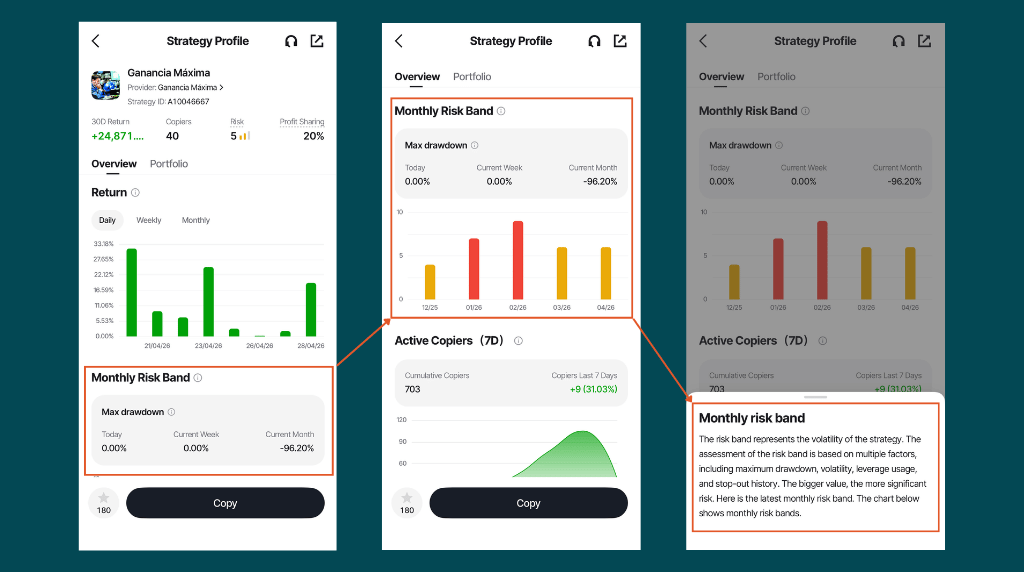
All signal providers on Vantage have a Monthly Risk Band, which represents the volatility of their strategy. The Monthly Risk Band is represented by a numeric value from 0 to 10, where 0 is low risk and 10 is high risk. It’s assessed based on factors such as:
- Maximum drawdown
- Volatility
- Leverage usage
- Stop-out history
The bigger the value of a signal provider’s Monthly Risk Band, the more significant the risk in copying them. As a general principle: It’s better to be more conservative with risk than aggressive in pursuit of short-term returns.
Preferred Markets and Products
Which markets are you comfortable being exposed to?
A lead trader who specialises in forex copy trading may trade currency pairs you’re unfamiliar with, or carry overnight swap costs that affect your account differently from theirs. Always review a provider’s frequently traded products before copying them.
Time Horizon and Trading Style
Do you prefer a signal provider who trades frequently and closes positions within the day, or one who holds for weeks?
Here’s what copiers need to consider based on different trading styles of signal providers:
- Day Traders: Higher activity that comes with more transaction costs and faster-moving results.
- Swing and Position Traders: Fewer trades, but with potential for larger moves held through volatility.
Misaligning your time horizon with a provider’s trading style is one of the most common errors in copy trading (more on that later).
Choosing a Signal Provider: The 5-Factor Audit Framework
Once you’ve defined your own copy trading goals, use Vantage’s five-factor Signal Provider Audit Framework to evaluate any lead trader before you copy them.
1. Historical Performance and Consistency
Return percentage is a starting point, not a conclusion. What matters more is how that return was achieved and over what time period.
Look for signal providers with a verified track record of at least 12 months. A provider who’s generated consistent monthly returns across different market conditions, including volatile periods, is far more credible than one whose track record spans 60 or 90 days of favourable price action.
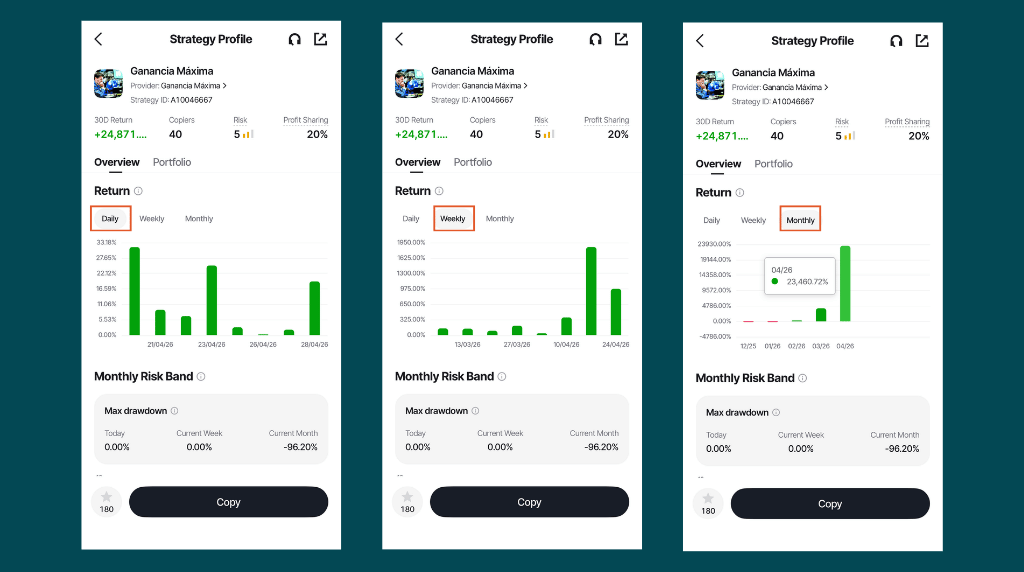
On the Vantage App, you can view a signal provider’s daily, weekly, and monthly return history directly on their profile. Look for a return chart that trends gradually upwards, not one with sharp spikes followed by steep drawdowns.
2. Maximum Drawdown vs. Recovery Factor
Maximum drawdown measures the largest peak-to-trough decline in a signal provider’s account equity—and it’s one of the most important risk management metrics available.
As a general rule of thumb:
- Under 20% Drawdown: Generally indicates disciplined risk management.
- 20–50% Drawdown: Higher risk; copiers need to assess recovery time carefully.
- Above 50% Drawdown: Significant risk; a bad run could substantially affect a copier’s account balance.
However, a signal provider’s drawdown doesn’t provide the full picture. Recovery factor, otherwise known as how quickly and consistently the lead trader bounces back, matters just as much.
- A lead trader who experiences a 25% drawdown and recovers within six weeks shows resilience.
- A lead trader who experiences a 15% drawdown and hasn’t recovered in four months might signal a struggling strategy.
As mentioned earlier, the Monthly Risk Band in the Vantage App gives copiers a consolidated view of a signal provider’s drawdown risk, factoring in their maximum drawdown, volatility, and stop-out history across rolling 30-day windows.
3. Trading Style: Day Trading or Swing Trading?
A signal provider’s trading style directly affects the frequency, cost, and nature of the trades being copied into a follower’s account.
| Trading Style | Typical Risk Level | Best For | Key Metric to Watch |
| Day Trading | Medium to High | Traders who want regular activity without overnight exposure | Win rate and daily return consistency |
| Swing Trading | Medium | Patient traders comfortable holding positions for days or weeks | Win rate and maximum drawdown |
| Position Trading | Low to Medium | Long-term-oriented copiers with lower activity preference | Swap costs and monthly return stability |
Mismatching your style preference with a provider’s approach is avoidable, but only if you check before you copy. A copier uncomfortable with overnight exposure, for example, shouldn’t copy a swing trader who regularly holds positions across the weekend.
4. Assets Under Management (AUM) and Follower Count
A signal provider’s copy assets under management (AUM) and active follower count are useful credibility indicators, but they need careful interpretation. These metrics need to be used as a contextual layer instead of standalone quality signals.
- Growing Follower Count: Suggests the signal provider has attracted meaningful capital and community trust over time
- Rapidly Increasing Followers: May reflect recent short-term performance and should be used with caution
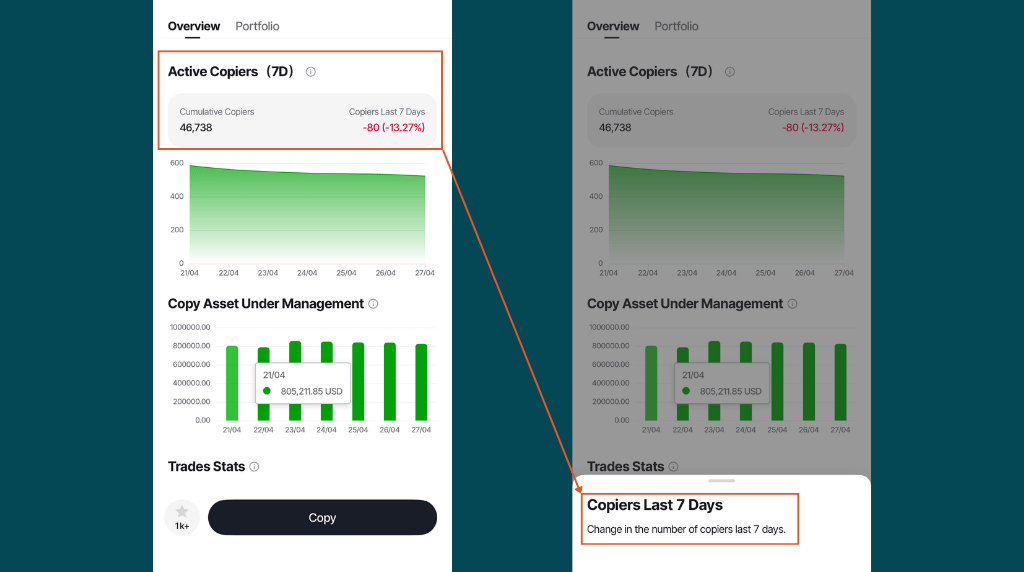
- Declining Active Copiers: An early warning signal that followers are losing confidence in the strategy.
On the Vantage App, copiers can view a signal provider’s:
- Active copiers and its change in the past 7 days
- Number of cumulative copiers
- Copy AUM
5. Lead Trader’s Product Focus
Forex copy trading signal providers who specialise in a narrow range of currency pairs can be easier to evaluate than those trading across many asset classes simultaneously. A concentrated product focus might signal that the strategy is more defined, the risk is more predictable, and the performance history is more comparable over time.
The type of traded instrument matters as well. If a lead trader primarily trades exotic currency pairs or high-volatility commodities, their risk profile may be higher than their headline metrics suggest.
On the Vantage App, each signal provider’s profile shows their most frequently traded instruments, the percentage of total trades each represents, and their win rate per product.

Are Trading Signals Legit? How to Spot Red Flags and Scams
When offered through a regulated, transparent platform with verified performance data and proper risk disclosures, copy trading signals can be legitimate. Yet, they are also the vehicle for some of the most common scams in retail trading. In fact, the Financial Conduct Authority (FCA) has specifically warned about finfluencer-style promotions pushing consumers towards unregulated signal services with unrealistic return promises.1
Here are five red flags that copy traders should take into consideration:
- Unrealistic Return Claims: Any provider claiming guaranteed returns, 90%~ win rates, or inconsistent triple-digit monthly gains should be treated with extreme caution. Remember, no trading strategy eliminates market risk entirely.
- No Verified History: Return screenshots on social media or channels like Telegram and WhatsApp aren’t the same as a verified live track record on a regulated platform. If their performance history can’t be independently verified, don’t copy them.
- Vague Risk Disclosure: Credible lead traders have clear risk metrics visible on their profile. If drawdown data, risk band, or strategy description are absent or vague, that’s a definite red flag.
- Heavy Telegram or Chat-Group Hype: Providers who generate their following primarily through social media rather than verified platform performance aren’t subject to the same oversight as those operating within a regulated broker’s ecosystem.
- Unclear Fee Structures: On regulated copy trading platforms, profit-sharing ratios are disclosed transparently and settled through the platform. Any request for off-platform payment or upfront subscription fees warrants caution.
| Feature | ✅ Green Flag | 🚩 Red Flag |
| Track Record | Verified, 12+ months of live trading history | Unverified, short history, or screenshots only |
| Maximum Drawdown | Under 20% with clear recovery pattern | Above 50% and/or or no drawdown data visible |
| Return Claims | Consistent monthly returns with transparent methodology | Inconsistent triple-digit monthly spikes with no explanation |
| Communication | Transparent strategy description on the platform | “Secret algorithm” or vague trading approach |
| Fee Structure | Clearly disclosed profit-sharing ratio on the platform | Hidden fees, upfront payment requests, or off-platform payments |
| Promotion Channel | Listed on a regulated, authorised platform | Primarily promoted via dubious Telegram or WhatsApp groups |
| Risk Disclosure | Prominent risk warnings on the platform | No clear mention of risk, losses, or suitability |
How to Choose a Signal Provider on Vantage
Here’s a step-by-step guide to selecting and starting to copy a signal provider on the Vantage App:
1. Open the Copy Trading Section
Navigate to the Trade tab in the Vantage App and select Copy. This takes you to the Community Page, where all available signal providers are listed.

2. Browse and Filter Vantage Signal Providers
The Vantage App categorises its signal providers across five areas:
- Highest Rated
- Highest Return
- Most Copied
- Highest Win Rate
- Low Risk
Copiers can choose to further customise their filters based on metrics such as return and trading category.

Note: These categories reflect algorithmic ranking — they don’t constitute a recommendation or guarantee of future performance.
3. Review the Signal Provider’s Profile
In the Vantage App, you can click on any signal provider to access their strategy profile. Review their monthly return history, risk band, maximum drawdown, active copier count, AUM, trade stats, and frequently traded products. Apply the five-factor audit framework before proceeding.

4. Choose Your Copy Mode
Before copying, select your preferred Copy Mode in the Vantage App. There are three Copy Modes to choose from:
- Equivalent Used Margin: A Copier’s trade volume is based on margin levels proportional to the Signal Provider’s.
- Fixed Lots: A Copier’s trade volume is fixed to a pre-set value. For example, if you input 0.01 lots per order, your copied volume will always be 0.01 lots.
- Fixed Multiples: A Copier’s trade volume is a set multiple of the Signal Provider’s original order size. For example, a multiple of three means each copied position is three times the size of the original. This is suitable if you have a higher risk tolerance or full confidence in the lead trader’s strategy.
Each Copy Mode determines how a Copier’s trade volume mirrors the provider’s original order size. Take note that Copy Modes are configured at the start of each individual copy trade on the Vantage App. This lets users adjust their trades as needed, providing added flexibility.

5. Set Stop-Loss and Take-Profit Levels
Before confirming that you want to copy a Signal Provider, you’ll need to first set your own stop-loss and take-profit levels. These apply to your copied positions independently of the lead trader’s levels.

Once you select Submit, remember to monitor your Signal Provider’s performance regularly. Check their profile at least once weekly. If their risk band rises, active copier count falls sharply, and/or drawdown deepens without recovery, it’s time to reassess. On the Vantage App, you can stop copying at any time.
Choose the Right Signal Provider Aligned With Your Unique Trading Goals
A signal provider with a 30-day return of +62% may look like an obvious choice. But that figure alone tells you very little about whether they’re right for you because your outcomes as a copier depend on far more than headline returns.

What actually shapes results:
- Capital Allocation and Copy Mode: The amount you allocate and the copy mode you select directly affect how a signal provider’s strategy translates into your account.
- Fees and Costs: Spreads, financing charges, and transaction costs all affect your account balance, sometimes significantly over time.
- Risk Alignment: Your own risk tolerance may not match the signal provider’s strategy, even if their returns look attractive.
- Execution Differences: Slippage and timing delays mean you won’t always get the same fill prices as the lead trader.
Visible performance metrics can also be misleading. Short track records, cherry-picked time windows, and leaderboard rankings based on raw returns rather than risk-adjusted performance can all create a false impression of consistency. No single metric tells the full story.
That’s why Vantage’s five-factor audit framework—performance consistency, drawdown and recovery, trading style, AUM and follower trends, and product focus—exists. Use it alongside your own clearly defined goals before copying anyone. And once you start copy trading, keep monitoring your results. Signal providers can change their strategies, increase their leverage, or shift their product focus without prior notice.

If you’re ready to start copy trading, consider opening a Vantage Copy Trading Account today and browse Signal Providers on the Vantage App.
Frequently Asked Questions (FAQs)
How do I know if a signal provider is profitable?
A signal provider’s profitability should be assessed over a sustained period, not a single month. Look for providers with a verified track record of at least 12 months, consistent positive monthly returns across different market conditions, and a profit factor that accounts for both winning and losing periods.
On the Vantage App, you can view daily, weekly, and monthly return data directly on each Signal Provider’s profile. Be cautious of short track records or providers whose returns are concentrated in one high-performing stretch.
What is a good drawdown for a signal provider?
As a general benchmark, a maximum drawdown under 20% typically indicates disciplined risk management, while anything above 50% suggests a high-risk approach unsuitable for most copiers. That said, drawdown must always be assessed alongside recovery time. A provider who recovers from a 25% drawdown within two months might show more resilience than one whose 15% drawdown has persisted for over six months.
On the Vantage App, the Monthly Risk Band consolidates maximum drawdown, volatility, leverage usage, and stop-out history into a single rolling indicator.
Can I copy multiple signal providers at once?
Yes. On the Vantage App, you can copy multiple Signal Providers simultaneously, each with their own allocated capital and copy mode settings. Spreading your allocation across more than one Signal Provider with different trading styles, market and product focuses, and risk profiles might help reduce the impact of any single provider that’s underperforming. As a practical guideline, consider limiting the capital allocated to any single Signal Provider to avoid overexposure to one strategy.
Which is the best copy trading signal provider?
There’s no universally ‘best’ signal provider. The right choice for you depends on your capital, risk tolerance, preferred markets, and time horizon. Rather than searching for the top-ranked Signal Provider, use Vantage’s five-factor Signal Provider Audit Framework—evaluate historical performance consistency, maximum drawdown and recovery, trading style alignment, AUM and follower count trends, and product focus.
On the Vantage App, users can filter Signal Providers by risk band, return period, and categories like “Highest Win Rate” and “Most Copied” to narrow your search based on your specific criteria.
What is the success rate of copy trading?
There’s no universal success rate for copy trading. Outcomes vary significantly depending on the signal provider chosen, the products traded, the level of leverage involved, the copy mode selected, and your own risk controls. Regulatory bodies including the FCA have noted that CFD-based copy trading is complex and high-risk, and that past performance data doesn’t guarantee future results. As such, the most meaningful measure isn’t a platform-wide statistic; it’s whether the specific signal provider and strategy you chose aligns with your individual goals, risk tolerance, and capital over a sustained period.
RISK WARNING: CFDs are complex financial instruments and carry a high risk of losing money rapidly due to leverage. You should ensure you fully understand the risks involved and carefully consider whether you can afford to take the high risk of losing your money before trading.
Disclaimer: The information is provided for educational purposes only and doesn’t take into account your personal objectives, financial circumstances, or needs. It does not constitute investment advice. We encourage you to seek independent advice if necessary. The information has not been prepared in accordance with legal requirements designed to promote the independence of investment research. No representation or warranty is given as to the accuracy or completeness of any information contained within. This material may contain historical or past performance figures and should not be relied on. Furthermore, estimates, forward-looking statements, and forecasts cannot be guaranteed. The information on this site and the products and services offered are not intended for distribution to any person in any country or jurisdiction where such distribution or use would be contrary to local law or regulation.
Reference
- “Is Copy Trading Still Popular in 2022? – Finance Magnates”. https://www.financemagnates.com/forex/analysis/is-copy-trading-still-popular-in-2022/. Accessed 13 April 2023.