Access Restricted
Your access to this website is restricted.
Our website and services are not available to, and are not intended for, individuals who are citizens or residents of the United States, or entities incorporated in or conducting business within the United States.
If this does not apply to you and you believe you have received this message in error, please contact us at [email protected] for further assistance.
If you fall into any of the above categories, please exit the site.
Important Information
Thank you for visiting the Vantage Markets website. Please note that this website is intended for individuals residing in jurisdictions where accessing it is permitted by Vantage and its affiliated entities do not operate in your home jurisdiction.
By clicking 'I CONFIRM MY INTENTION TO PROCEED AND ENTER THIS WEBSITE', you confirm that you are entering this website solely based on your initiative and not as a result of any specific marketing outreach. You wish to obtain information from this website based on reverse solicitation principles, in accordance with the applicable laws of your home jurisdiction.
I CONFIRM MY INTENTION TO PROCEED AND ENTER THIS WEBSITEen

Language
SEARCH
-
AllTradingPlatformsAcademyAnalysisPromotionsAbout
-
Search query too short. Please enter a full word or phrase.
-
Keywords
- Forex Trading
- Vantage Rewards
- Trading Fees
Popular Search
- Trading Accounts
- MT4
- MT5
- TradingView
- Promotions
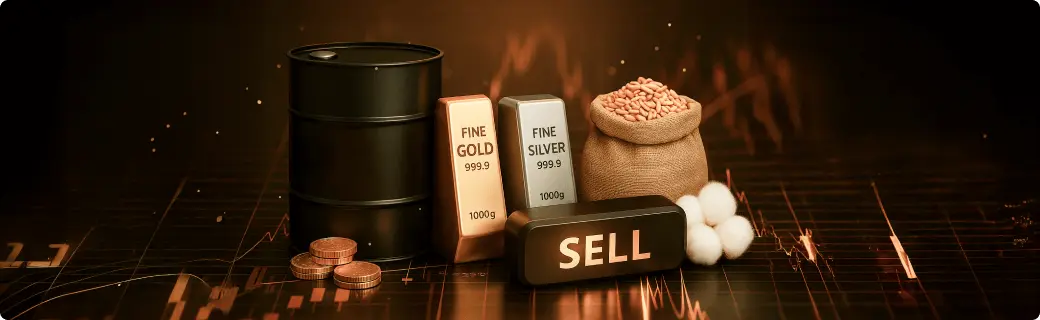
The commodities market is where raw materials crucial to the global economy change hands. Due to the importance of energy products like oil and gas; metals and minerals like gold, copper and diamonds; agricultural output like sugar, wheat, coffee beans and livestock; and other primary resources that can be bought and sold, the commodities markets remain highly traded at all times.
This, combined with the large range of different commodities on offer – some with their own unique economic cycles – may present potential opportunities for traders seeking to diversify against risk, or explore different trading approaches.
To make the best of the dynamic commodities markets, traders should adopt a systemic approach, armed with a ready toolbox of various trading strategies to capitalise on changing market conditions.
7 Key Commodities Trading Strategies
Here are seven popular commodities trading strategies that can be useful for traders of all experience levels.
- Technical Analysis-based Trading
- Fundamental Analysis-based Trading
- Momentum Trading
- Swing Trading
- Range-bound Trading
- Diversification and Hedging
- Day Trading
Strategy 1: Technical Analysis-based Trading
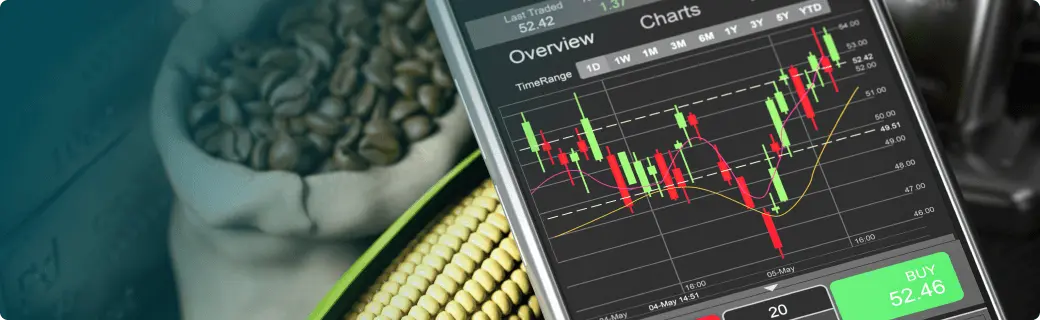
Technical analysis focuses on reading price action on candlestick charts. With the help of indicators and charting tools to discern patterns, measure speed and direction of changes, and gauge the likelihood of incoming price trends, traders may be able to make more informed decisions when navigating the commodities markets.
This commodities trading strategy is highly, well, technical, as it requires a good understanding of price charts and how to read them. Additionally, traders will also need to learn various technical indicators – of which there is an extensive range available – including what they are designed to measure, how they work, their strengths and limitations.
To be skilful at technical analysis, traders should learn a variety of different technical indicators, and how to correctly interpret them so as to build an accurate picture of what’s truly going on in the market. More advanced traders often tweak the parameters of their favourite technical indicators to better fit their goals and objectives.
Strategy 2: Fundamental Analysis-based Trading
Fundamental analysis refers to the practice of studying and tracking the key drivers (or fundamental factors) of market prices. Just like earnings reports are often a predictor for stock prices, supply and demand levels – and the developments that impact them – will influence commodity prices, sometimes to surprising degrees.
It’s important to note that different commodities can be driven by different fundamental factors. For instance, during periods of high inflation, gold often sees increased demand, with prices rising in tandem. Meanwhile, inclement weather can impact the supply of agricultural produce such as wheat. With lesser availability to go around, prices for the commodity tends to increase as buyers bid higher prices to get their hands on remaining stock.
In short, fundamental analysis can help a trader understand the character of particular commodities, explaining their price action. Understanding global events and macroeconomic trends can provide context on how different commodities may behave in the market.
Strategy 3: Momentum Trading
Momentum trading is a strategy that seeks to capitalise on a price trend that is picking up steam, such as during a price breakout. The idea is that once prices start moving in a direction, they tend to stay moving in the same direction.
An important component of this strategy is that traders use technical indicators to measure the momentum of the price trend based on trading volume, hence giving this strategy its name. Oscillators are most often used to measure momentum in this strategy; they can also help identify trends.
Momentum trading typically involves analysing market trends to identify when a commodity’s price may be accelerating or decelerating. Traders may use indicators to interpret potential entry and exit points, though markets can reverse unexpectedly. However, as with any strategy, this involves risks, and price reversals can occur without warning.
Strategy 4: Swing Trading
Swing trading is a strategy that at first glance may appear similar to momentum trading, but there are differences between the two.
In swing trading, a trader attempts to take advantage of the natural movements of markets, which rarely move in a straight line. Instead, prices tend to move up and down, swinging back and forth between highs and lows as they progress.
Thus, a swing trader attempts to trade these price swings, using established levels of resistance and support as entry and exit points.
Just like in momentum trading, a swing trading strategy calls for trading along with the price trend. However, the difference is that a swing trader may keep a trade open for longer (compared to momentum trading) as they attempt to ride out the entire price swing. Thus, a swing trading strategy is more suitable to short- to medium-term trading. These short-term strategies can be high risk and may not be suitable for all traders, especially without a well-defined plan and risk controls.
Strategy 5: Range-bound Trading
A variant of swing trading, range-bound trading works in a similar way. In this commodity trading strategy, traders look for range-bound markets – a state in which the price moves between clearly established levels of resistance and support, but rarely breaks out to higher highs or lower lows.
Once the market enters a range-bound state, the trader puts the range-bound strategy into action simply by placing trades at or near support or resistance levels. Thus, succeeding with this strategy requires the use of technical indicators to understand market cycles and patterns to identify turning points. Some of these include moving averages, oscillators, and lines of support and resistance.
Strategy 6: Diversification and Hedging
Diversification and hedging can help commodities traders reduce risk in different ways.
Firstly, diversification involves choosing different commodity markets to trade. Doing so helps a trader to reduce price volatility overall, as some commodities have distinct supply and demand cycles. Therefore, spreading out your holdings among loosely correlated markets can offer some degree of protection during market downturns.
Next, hedging can involve using instruments such as futures contracts to manage exposure to commodity price movements. While actual futures trading is more advanced and typically conducted on exchanges, the concept helps illustrate how traders may attempt to manage risk. Note that futures trading is not offered through CFDs and is an advanced strategy that may not be suitable for all traders.
Strategy 7: Day Trading
Day trading is a short-term commodity trading strategy that focuses on opening and closing trades in quick succession, aiming to capture short-term market movements during the course of a trading day. This approach carries significant risk and requires fast decision-making.
Day traders look for trading opportunities that span the trading day but ensure all positions are closed before the market closes to avoid overnight risk. This may involve a lower number of trades, but each trade may be held for a longer period—ranging from several hours to the full trading day.
Due to its characteristics, day trading offers commodity traders a way to take advantage of quick price movements while keeping exposure brief. This style of trading is fast-paced, and success requires having a clear plan and the discipline to stick with it. These short-term strategies can be high risk and may not be suitable for all traders, especially without a well-defined plan and risk controls.
Developing your personalised trading strategy
Having a personalised trading strategy can be helpful whether you’re first starting out, or already have some experience with commodities trading. Think of it as customising your own toolbox field with different tactics and tools that can help you approach market changes in a more structured and systematic way.
Here are a few key factors to consider.
Set goals and define risk tolerance
Start by establishing clear trading objectives – i.e., what do you want to trade and how much profit are you aiming for. This will give you a clearer idea of suitable trading opportunities to start with.
Importantly, you should also define your risk tolerance – how much you are willing to lose in your trade. This is essential because nothing is guaranteed in trading, and determining your risk tolerance beforehand will help alert you when you are overtrading.
Backtesting and Paper trading
Before committing to live trade and risking your money, it might be prudent to test your trading strategies using historical data to see how it would play out.
This is called back testing or paper trading, and can be useful in evaluating how a strategy might have performed under past conditions, although past performance does not guarantee future results. Additionally, back-testing can provide valuable insights into how your chosen commodity market may move in response to events similar to previously established ones. Remember: In trading, history may not repeat itself, but it often rhymes.
Continuous learning and adaptation
In developing your own trading style, it is important to adopt a mindset of continuous learning and adaptation. Recognise that trading has the potential to be intellectually engaging and personally fulfilling, though it also requires constant learning and honing of your skills and knowledge.
The commodity market is highly complex and dynamic, and is constantly under the sway of myriad geopolitical and macroeconomic factors. Given the dynamic nature of the commodities market, staying informed about global developments can help traders better understand potential market movements.
In short, the path of a commodity trader requires the willingness to never stop learning and the commitment to keep adapting your strategies as your experience grows.
Managing risk in commodity trading
Understanding common risks
Commodity trading comes with risks that traders should understand before attempting to trade.
Firstly, it’s important to understand that commodities can be highly volatile, spiking or falling in price over short periods. One such example is oil, which is highly sensitive to supply levels, and anything that can impact them. For instance, oil prices often experience heightened volatility when there is unrest or instability in the Middle East, a key oil producing region, making it crucial to keep track of geopolitical events.
Secondly, commodity trading is often done via CFDs, which involves the use of leverage. While leverage can allow traders to control a larger position with a smaller initial deposit, it also amplifies trading outcomes. In a leveraged trade, both profits and losses are magnified to the same degree, making it easy for losses to exceed your initial capital. Thus, it’s essential to understand the impact that leverage can have on your account.
As explained in the previous section, the commodities market is highly influenced by macroeconomic and geopolitical factors. This means traders need to be aware that there are many “external” factors that can impact their trades, and should make allowances for them during planning.
Risk management techniques
Managing risk is a core part of commodity trading, and there are three approaches to consider.
Trading platforms offer a variety of risk management tools in the form of stop-loss orders and take-profit orders. These automatically close a trade once a profit or loss level has been reached, and can help support risk management efforts. It's important to understand how the stop-loss and take-profit functions offered by your broker work, including their limitations and appropriate use.
Another aspect of risk management involves understanding appropriate position size. This simply means controlling the maximum amount you can risk with each trade; the goal is to not allow a series of bad trades to wipe out your account. Some experienced traders choose to limit position sizes to a small percentage of their overall budget – for example, 1% to 5% – as part of their personal risk management plan.
Finally, as discussed earlier, consider diversifying your positions across different commodity markets, preferably those with historically low correlations, or with price cycles that move counter to each other. This will help moderate the effects of volatility spikes.
Explore More About commodities Trading
-
Why Trade Commodities
Learn about the factors that make commodities an important asset class and why traders consider them as part of a diversified trading strategy.
-
How to Trade Commodities
Explore a step-by-step guide on trading commodities, designed to help traders understand the basics and key considerations involved.
-
What are Commodities
Discover how raw materials like gold, oil, and wheat influence global markets. This section breaks down commodity types (hard and soft), their economic significance, and how traders may use them as part of their trading strategies.
Award-Winning Broker
-
Most Innovative
BrokerFX Broker Tester
-
Best CFD
BrokerGlobal Brands Magazine
-
Best APAC
Region BrokerADVFN International Financial Awards
Trade Commodities CFDS On Different Types Of Trading Platforms
MetaTrader 4
- 30 Built-in technical indicators
- 31 Analytical Charting Tools
- 9 Time-Frames
- 4 Types of trading orders
MetaTrader 5
- 38 Built-in technical indicators
- 44 Analytical Charting Tools
- 21 Time-Frames
- 6 Types of trading orders
TradingView
- 15+ chart types
- 100+ in-built indicators
- 50+ Drawing tools
- 12 alert conditions
Vantage Mobile App
- 55 Deposit Methods Globally
- 220+ Daily Product Analysis
- 16 TradingView Indicators
- 80,000+ Copy Traders
Choose a Trading Account Based on Your Experience Level
-
1
Any level
-
2
Beginner Traders
For beginner traders looking for direct market access with no commissions.
- Tight spreads from 1.1 pip.
- No extra commissions on trading volume.
-
3
Experience Traders
Offering seasoned traders razor-sharp spreads, low commissions, and deep liquidity.
- Tight spreads from 0.0 pip.
- Commisssions from USD$3.00 per standard lot, per side.
-
4
Professional Traders
For professional traders and money managers who trade large volumes.
- Tights spreads from 0.0 pip.
- Commissions from USD$1.50 per standard lot, per side.
-
1
Register
Quick and easy account opening process.
-
2
Fund
Fund your trading account with an extensive choice of deposit methods.
-
3
Trade
Trade with spreads starting as low as 0.0 and gain access to over 1,000+ CFD Instruments.
Frequently Asked Questions
-
1
What is the best commodities trading strategy for beginners?
The best commodities trading strategy would be the one that is aligned most closely with your trading preferences, goals and objectives.
This would mean having to first work out what those are by developing your own personalised trading plan. Once you do so, you will find some commodity trading strategies to be a better fit for you.
-
2
How to trade commodities successfully?
Commodity prices are driven by supply and demand level, which in turn are impacted by an array of geopolitical and macroeconomic events. Weather, war, policy changes and inflation levels are just some of the factors that can impact the commodity markets. There are no guarantees in trading, but staying informed and disciplined can help improve decision-making.
-
3
How do I manage risk while trading commodities?
Risk management is critical when trading the dynamic commodities market. Traders should consider the proper use of stop-loss and take-profit orders, diversifying across several different commodities, and setting appropriate position sizes, taking leverage into account.
-
4
What is the safest commodity to trade?
No commodity is inherently “safe” to trade, as all are subject to volatility and external influences. The suitable commodity to trade would be one of which you have the clearest understanding and deepest knowledge. The more you study and analyse a commodity, the better you may understand its price behaviour. However, all trading involves risk, and no prediction method is foolproof.
Disclaimer: The information is provided for educational purposes only and doesn't take into account your personal objectives, financial circumstances, or needs. It does not constitute investment advice. We encourage you to seek independent advice if necessary. The information has not been prepared in accordance with legal requirements designed to promote the independence of investment research. No representation or warranty is given as to the accuracy or completeness of any information contained within. This material may contain historical or past performance figures and should not be relied on. Furthermore estimates, forward-looking statements, and forecasts cannot be guaranteed. The information on this site and the products and services offered are not intended for distribution to any person in any country or jurisdiction where such distribution or use would be contrary to local law or regulation.