



The forex market is the largest financial market in the world, with average daily turnover reaching $9.6 trillion in April 2025 [1]. Its scale has led to rising interest from Indian residents looking to enter the market.
For traders in India, though, the main question is not whether forex trading is possible, but how they can start trading it legally. Forex trading is legal, but it is subject to strict rules set by the Reserve Bank of India (RBI) and the Securities and Exchange Board of India (SEBI).
Before placing a first trade, it is important to understand what is permitted, which currency pairs can be traded, and how the market must be accessed under Indian regulations.
Key Points
- To trade forex in India, traders need to use a SEBI-registered broker, complete KYC, and trade only approved currency derivatives on recognised exchanges.
- Indian residents can trade only seven approved currency pairs, and these are offered as exchange-traded currency derivatives rather than offshore spot forex contracts.
- A disciplined approach matters most, including learning the basics, verifying the broker, managing risk carefully, and reviewing each trade over time.
How to Start Forex Trading in India
Getting started in forex trading in India is less about rushing into the market and more about following the right process. Here is a breakdown of how to get started:
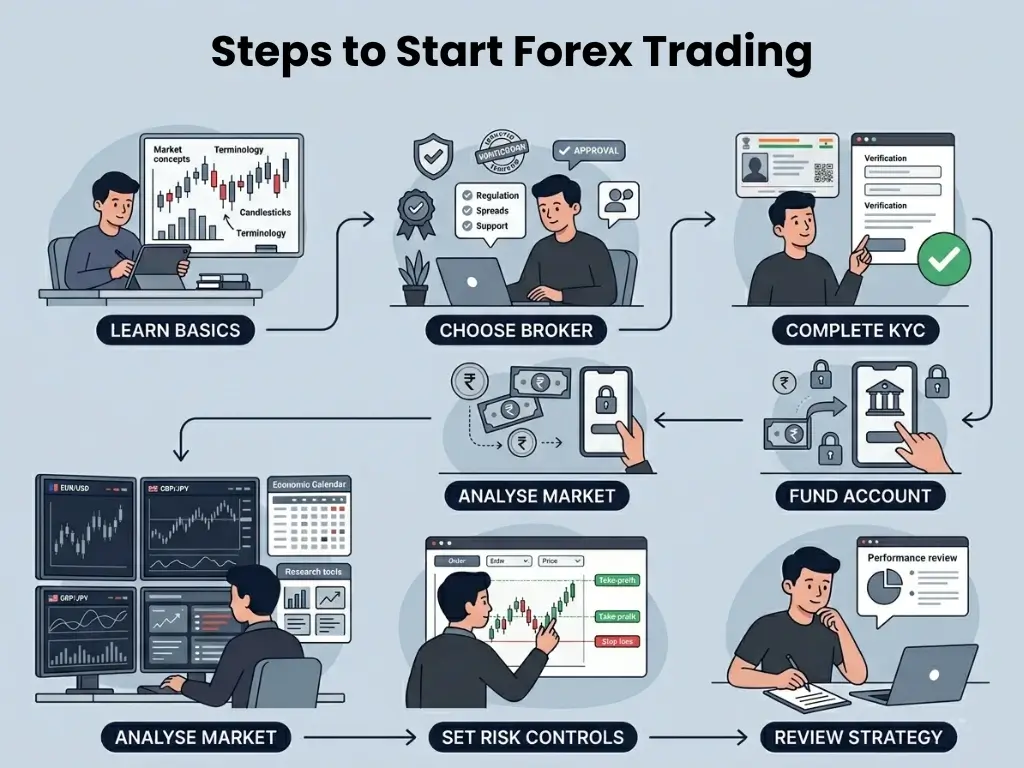
Step 1: Learn the Fundamentals
Understand how currency pairs move, what affects exchange rates, and how leverage can increase both gains and losses. Get familiar with futures and options, learn to read candlestick charts, and use basic tools such as support and resistance, moving averages, RSI, and MACD.
In India, currency markets are influenced by local factors such as RBI policy, inflation, and INR liquidity, as well as global drivers including US rate decisions, oil prices, and overall market sentiment.
A solid foundation protects you from costly beginner mistakes. Do not skip this step in a rush to start trading. For a more structured introduction, explore our forex beginner course.
Step 2: Choose a SEBI-Registered Broker
Select a broker with valid SEBI registration that provides access to currency derivatives on the NSE, BSE, or MCX-SX. Compare brokers based on the following:
- Spread and brokerage costs
- Platform quality, including whether they offer MetaTrader 4, MetaTrader 5, or a proprietary app
- Margin requirements per contract
- Customer support responsiveness and language availability
- Educational resources for beginners
Verify the broker’s SEBI registration number directly on the SEBI Intermediaries Portal before opening an account. Do not rely solely on the broker’s own website. The RBI also maintains an Alert List of unauthorised entities — check this list to confirm your broker does not appear on it.
Step 3: Complete KYC and Open Your Trading Account
Once you choose a broker, you will first need to open your trading account. After that, you will need to complete its KYC and account verification process before you can begin trading. This usually involves submitting identity and account-related documents, linking your bank account for fund transfers, and receiving your Unique Client Code (UCC).
A UCC is required for individuals trading in the Indian securities market. Without it, you will not be able to place trades. Depending on the broker, the verification process may take anywhere from the same day to a few business days.
Step 4: Fund Your Account
Fund your account with a conservative amount that fits your budget and risk tolerance. The minimum deposit and margin required will vary by broker, product type, and market conditions.
Only use funds you can afford to put at risk. It also helps to set a clear monthly trading budget and treat it as a fixed limit.
Step 5: Select Your Currency Pair and Analyse the Market
Many beginners start with USD/INR because it is one of the most actively traded currency pairs on Indian exchanges. As you become more familiar with the market, you may also look at other permitted currency pairs available through domestic exchanges.
Market analysis usually combines both technical and fundamental factors:
- Technical: Moving averages, RSI, MACD, candlestick patterns, support and resistance
- Fundamental: RBI policy announcements, inflation data (CPI), US Non-Farm Payrolls, crude oil price movements, India’s trade balance figures
Check an economic calendar daily. Volatility around major data releases can move currency pairs sharply, and entering a position without knowing what announcements are scheduled is a common and costly oversight.
Step 6: Place Your Trade with a Stop-Loss and Take-Profit Order
Before entering a trade, define three things:
- Entry price
- Stop-loss level
- Take-profit target
These are the basic controls that help keep risk in check.
Risk no more than 1%–2% of your total trading capital on a single trade. As part of forex risk management, place your stop-loss at a logical technical level, such as below support for a buy trade or above resistance for a sell trade.
Set your take-profit so that the potential reward is at least 1.5 to 2 times the amount at risk.
Once the trade is live, let your orders manage the outcome. Changing your stop-loss after entering the trade can lead to larger losses than you originally planned for.
Step 7: Review, Journal, and Refine Your Strategy
After each trading session, record the key details of every trade, including your entry and exit price, position size, reasoning, and outcome.
Reviewing your journal regularly can help you spot patterns in your decisions, including what worked well and what needs improvement.
Use this record to adjust your strategy based on your own trading results rather than instinct or outside opinions. As market conditions change over time, regular review can help you keep your approach relevant and consistent.
Over time, a structured trading plan can help turn these review habits into a more disciplined and repeatable approach.
Which Currency Pairs Can You Trade in India?
The Reserve Bank of India (RBI) limits retail traders to seven approved currency pairs on domestic exchanges:
INR-based pairs:
- USD/INR (US Dollar / Indian Rupee)
- EUR/INR (Euro / Indian Rupee)
- GBP/INR (British Pound / Indian Rupee)
- JPY/INR (Japanese Yen / Indian Rupee)
Cross-currency pairs (on recognised exchanges only):
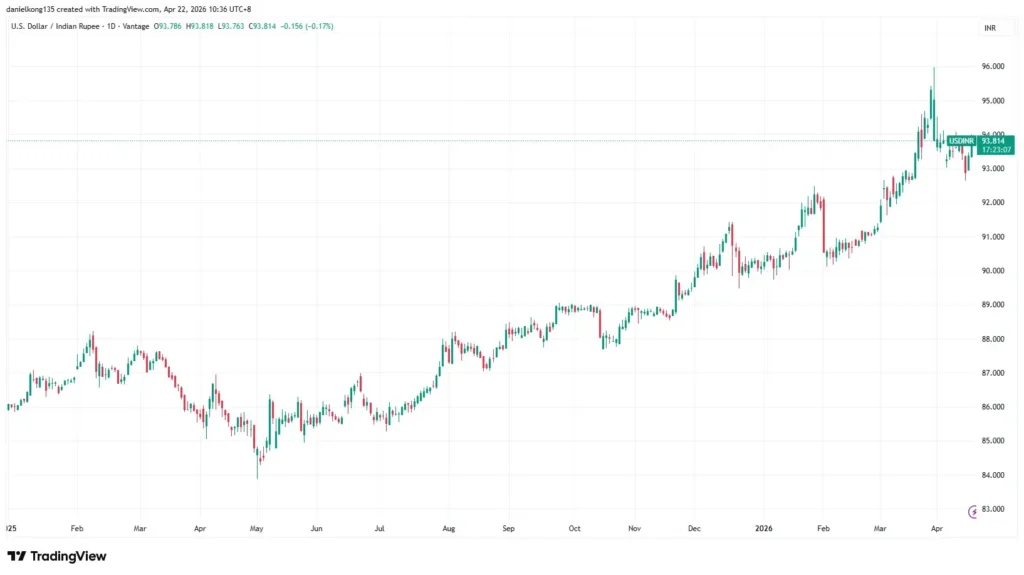
USD/INR is by far the most actively traded pair in India, with the highest liquidity, tightest spreads, and the deepest market for both futures and options.
Trading any other currency pair — including popular international pairs such as AUD/USD, USD/CAD, or EUR/JPY — is not permitted through domestic exchanges.
How Forex Trading Is Regulated in India
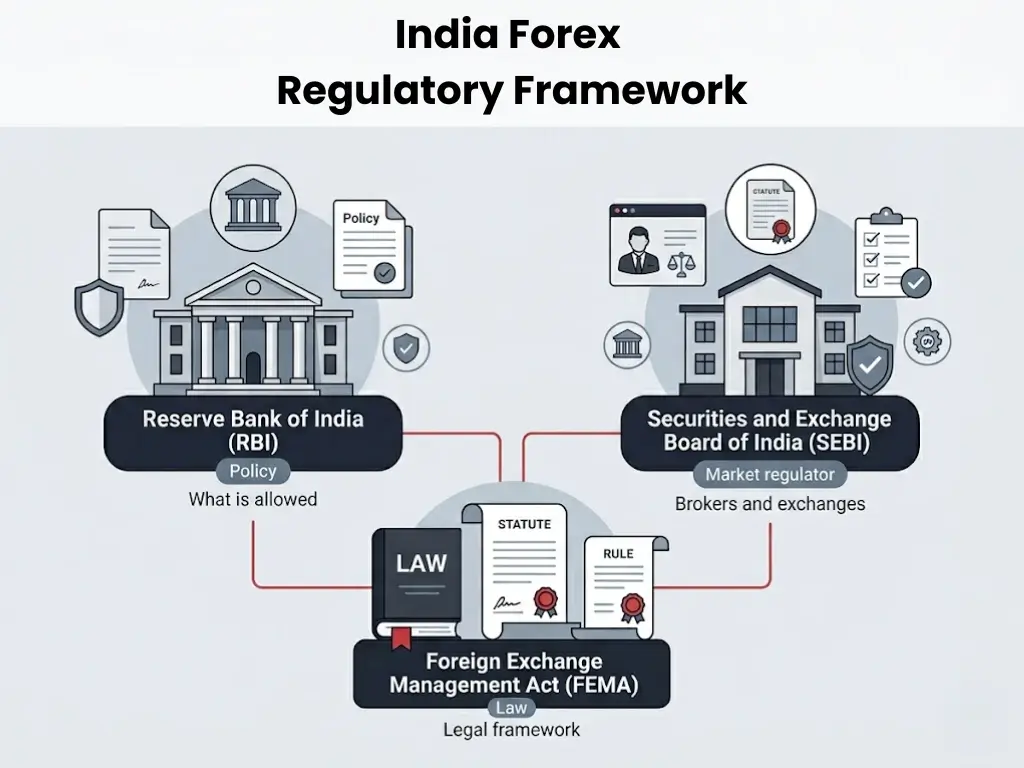
Forex trading in India is governed by three main frameworks: FEMA, the Reserve Bank of India (RBI), and the Securities and Exchange Board of India (SEBI).
- FEMA is the core law. It sets the rules for permitted currency transactions and restricts remittances abroad for speculative purposes. Violations can result in penalties.
- The RBI determines which currency pairs can be traded on domestic exchanges and maintains an Alert List of unauthorised entities. This list can help traders avoid non-compliant platforms.
- SEBI regulates brokers and exchanges, and brokers offering currency derivatives to retail traders must be SEBI-registered. It also helps ensure that trades are routed through authorised channels.
For a more detailed explanation, read our article: Is Forex Trading Legal in India?
Popular Forex Trading Strategies Used by Indian Traders.
Not all traders approach the forex market in the same way. The right approach often depends on factors such as time commitment, risk tolerance, and trading objectives.
- Day trading: This involves opening and closing positions within the same trading session, often aiming to capture smaller price movements in pairs such as USD/INR or EUR/INR. It usually requires close market monitoring, quick execution, and disciplined risk control.
- Swing trading: This approach involves holding positions for several days or weeks to capture broader market moves. It is often shaped by factors such as Reserve Bank of India (RBI) policy changes, economic data, or shifts in global market sentiment.
- Hedging: Businesses and individuals with foreign currency exposure may use currency futures to manage exchange rate risk. For example, someone expecting a US dollar payment at a later date may use USD/INR futures to reduce the impact of adverse currency moves.
- Options strategies: More experienced traders may use currency options to build strategies with defined risk parameters, such as buying calls or puts, or using spreads. These strategies usually require a stronger understanding of option pricing, time decay, and volatility.
These are only a few of the ways traders approach the forex market. For a broader overview of other methods and styles, read our article on 11 Forex Trading Strategies for Different Trading Styles.
Key Risks of Forex Trading in India
Before trading forex in India, it helps to understand that risk does not come from price movement alone. Market conditions, regulation, timing, and trader behaviour can all affect the outcome of a trade.
| Risk | What It Means | Why It Matters |
| Leverage risk | Margin trading increases both gains and losses. Even a small move against your position can lead to a much larger loss relative to your deposit. | This is one of the main reasons traders can lose money quickly in the forex market. |
| Liquidity risk | Some currency pairs are easier to buy or sell than others, especially during active market hours. Outside peak hours or near contract expiry, liquidity may fall. | Lower liquidity can make it harder to exit a trade at the expected price, which may lead to slippage. |
| Event risk | Prices can move sharply around major events such as RBI announcements, economic data releases, or geopolitical developments. | Sudden volatility can lead to larger-than-expected price swings in a short period. |
| Regulatory risk | Trading through unauthorised platforms or accessing non-approved currency pairs can breach Indian regulations. | This can expose traders to legal and compliance issues under FEMA. |
| Psychological risk | Emotions can affect decision-making, especially after losses or during periods of volatility. | Overtrading, chasing losses, or abandoning a plan can weaken consistency over time. |
| Counterparty risk | On unauthorised offshore platforms, there may be no local regulatory protection if the broker delays withdrawals, shuts down, or acts unfairly. | This adds another layer of risk beyond the trade itself. |
Taken together, these risks show that forex trading in India involves more than choosing the right currency pair. Market access, regulation, and discipline all play an important role.
A More Disciplined Approach to Forex Trading in India
Forex trading in India is possible, but it works within a clearly defined regulatory framework. From choosing a SEBI-registered broker to trading only approved currency pairs on recognised exchanges, the starting point is understanding how the market operates within Indian rules.
For beginners, the focus is often less on finding the ‘perfect’ trade and more on building the right process. A clear understanding of the rules, stronger forex risk management, and a disciplined routine can help create a more informed foundation for approaching the market over time.
Frequently Asked Questions
Is forex trading legal in India?
Yes, but only through SEBI-registered brokers on recognised exchanges such as the NSE, BSE, or MCX-SX. Indian residents may only trade the seven RBI-approved currency pairs, and using unauthorised international platforms or non-approved pairs would violate FEMA.
What is the best time to trade forex in India?
The best time often depends on the currency pair being traded and when market activity is highest. For a fuller breakdown of key trading sessions and active hours in IST, read our guide here.
How is forex trading taxed in India?
Income from currency derivatives traded on recognised Indian exchanges is generally treated as non-speculative business income and taxed at your applicable income tax slab rate.
Other charges, such as Securities Transaction Tax (STT) and GST on brokerage-related fees, may also apply. Loss treatment, filing rules, and audit requirements can vary, so it is worth checking the latest tax rules before filing.
What is the best forex trading app in India?
The most suitable forex trading app in India can vary based on factors such as regulation, charting tools, execution features, and ease of use. For a fuller comparison, read our guide on Best Forex Trading App in India 2026.
Can I trade EUR/USD in India?
Yes. EUR/USD is one of the three cross-currency pairs approved for trading on recognised domestic exchanges. It can only be traded as an exchange-traded derivative through a SEBI-registered broker.
What happens if I trade forex on an illegal platform?
Trading through an unauthorised platform or accessing non-approved currency pairs through an offshore broker would violate FEMA. This can lead to penalties, and it also means there may be no regulatory protection if the broker fails to process withdrawals or acts unfairly.
Do I need a separate account for forex trading?
Not always. Many SEBI-registered brokers offer currency derivatives through the same account used for other market segments, provided the currency segment is activated and your Unique Client Code (UCC) is in place.
References
- Global FX trading hits $9.6 trillion per day in April 2025 and OTC interest rate derivatives surge to $7.9 trillion: Triennial Survey – BIS” https://www.bis.org/press/p250930.htm Accessed 21 April 2026