

Hormuz hopes swing, AI lifts Nasdaq above 30,000

Jamie Dutta >
Jamie Dutta >
Jamie Dutta is a Market Analyst for Vantage. He comes with extensive experience as a full-time trader and financial market commentator, having worked as a trader in top tier investment banks and trading houses.
 Updated Wed, 2026 May 27 01:30

- CENTCOM denies Navy escort operations in Hormuz Strait
- Trump to make rare trip to Camp David as Iran tensions rise
- S&P 500 and Nasdaq hit record highs on AI and chip optimism
- Micron hits $1 trillion market value for first time
Forex
USD found a mild bid as it continued to range trade above the 50-day SMA at 98.93 and below a minor Fib level at 99.44. US Treasury yields did dip for a fourth straight day but geopolitical headlines and tensions between the US and Iran saw the buck in demand. Fed Governor Waller made a significant shift on the rates outlook in his first public remarks since April on Friday, arguing the Fed should drop its “easing bias” and open the door to a possible rate hike. Notably, Waller’s views have often better reflected the consensus within the Fed than known hawks like Logan. There are a host of Fed speakers this week.
EUR held below its 50-day SMA at 1.1658. Last week’s PMI data was very disappointing and led bond markets to reprice their previous high expectations of rate hikes this year. Traders now predict only two moves (+52bps) from more than three previously (+80bps). Wage growth figures also cooled. We can hear the sigh of ECB breathe from the UK! However, this week sees countrywide inflation data and a final look at Q1 GDP figures. The former, both headline and core, are expected to shift higher driven by energy prices.
GBP fell back to the 50-day SMA at 1.3437 as the pound underperformed most of its peers. It’s a light data week after the plethora of releases mid-month. That was broadly softer, with core services inflation weakening, activity and wages in the labour market easing, and weaker activity/price indices in the PMIs. Retail sales were also lower than we had been expecting. This has all pulled down on market expectations for BoE tightening with just under 50bp of hikes priced by year-end.
JPY weakenedas it pushed away from the 2025 top and 50-day SMA around 158.87/75. That means its closer to 160 and the intervention zone which took place in late April when the major fell from 160.72 down to a low of the day at 155.53. Tokyo CP is the main data point for the week which is a forerunner for nationwide figures.
Stocks
US Stocks: The S&P 500 added 0.61% to close at 7,519, the Nasdaq closed up 1.76% at 30,001 and the Dow Jones settled lower by 0.23% at 50,467. Six sectors were positive with Tech, Industrials and Materials rising more than 1%. Energy was the big laggard (-2.8%) with Consumer Staples and Healthcare both lower by more than 1%. Gains in AI-related stocks like Micron (+19.3%) and Marvell (+6.1%) drove the bulk of the indices gains, as the melt up in semiconductor and memory names showed no signs of stopping. The latter report earnings after the closing bell today. Appetite for the defensive sector remained subdued in the aftermath of cautious second quarter commentary seen in Walmart and Target earnings last week. Qualcomm rose 4.5%after itstruck an AI chip deal with ByteDance, Bloomberg reported.
Asian Stocks: Futures are mixed. APAC stocks were mixed with optimism and then less optimism over the weekend on US-Iran events. The ASX 200 was muted as energy and utilities lagged. The Nikkei 225 pulled back from a new record high on profit taking and mixed geopolitics. The Shanghai Composite and Hang Seng were mixed as the latter outperformed on tech strength.
Gold
Gold carried on range trading as the 50-day SMA eased to $4,656. The more price track sideways, the bigger the breakout and range expansion will be.
Day Ahead – Australia CPI and RBNZ Meeting
Australia April CPI is forecast to remain elevated at 4.4% y/y due to travel and clothing, though this should be offset by falling transport costs. Focus is on persistence rather than direction, with energy and second-round effects from the Middle East shock still driving upside risk. That will be keenly watched by the RBA’s policymakers. The bank recently highlighted the risk of de-anchored inflation expectations, and a hot set of data could firm up expectations of more RBA policy tightening this year. There’s just over one more 25bps rate hike by year end.
The RBNZ is expected to leave the Overnight Cash Rate steady at 2.25% for a third straight meeting. Recent data has been mixed with annual inflation above the 1-3% target range at 3.1%, but unemployment unexpectedly easing to 5.3%. Remember this data is only released quarterly but inflation expectations are already flashing warning signs with a recent sharp rise in 1-yr expectations to 3.41%. We get new economic forecasts at this meeting. Markets see around 4 bps priced into this meeting with around 18 bps in July and 68 bps in 2026.
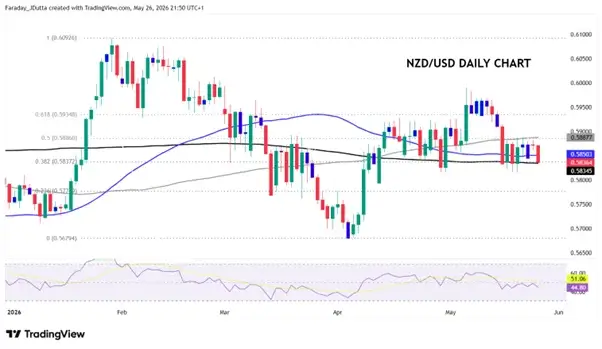
Chart of the Day – NZD/USD tracking sideways
The kiwi was the worst G10 performer yesterday, heading into the RBNZ meeting and OCR projections on Wednesday, with the Antipodeans generally underperforming amidst the modestly sour tone. Geopolitical uncertainty and mixed data support the case for a RBNZ pause, with a hawkish hold most likely.
That said, risks are skewed to tightening with new projections potentially showing tightening already in the third quarter. The 200-day SMA sits at 0.5834 along with a major Fib level (38.2%) of this year’s high to low at 0.5837. This support zone has capped the downside with the midpoint of the move at 0.5886 and the 100-day SMA at 0.5887. The upside Fib level (61.8%) is 0.5934.